
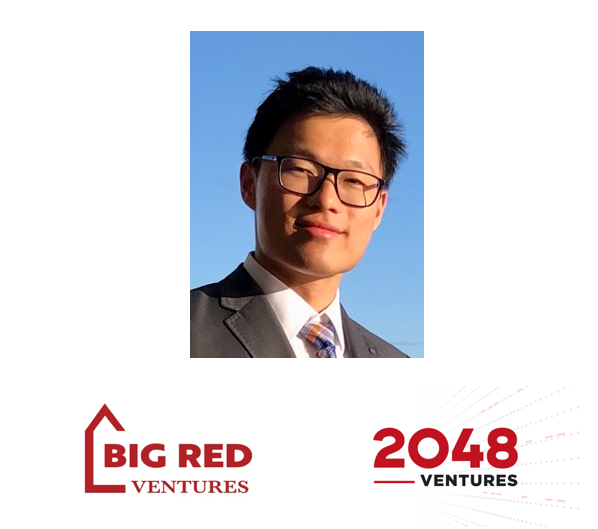
Big Red Ventures Fund Manager: Marshall Qian
Marshall: You had a pretty interesting experience before. Can you talk about coming out of school and what attracted you to VC? How did your prior experience shape that?
Zach: Yeah, so coming right out of school, I worked at an accelerator at the University of Toronto called Creative Destruction Lab, and it works with early-stage, so pre-seed and seed predominantly, deep tech companies. I started in the AI program there and worked across a couple of different streams during my time there. That experience, unsurprisingly, very quickly made me realize that I loved working with early-stage founders and working through those problems and challenges that companies face at an early stage.
It’s also unsurprising then that I wanted to break into early-stage VC, because it was the same stage of companies that I had been working with. But in general, starting in a university-based accelerator gave me exposure to those stories and the being of founders working on really massive problems and wanting to build things that change the world. I think that was super exciting to me, and so that’s what interested me in going into VC. It’s a bit more involved versus the accelerator lifestyle, but in a lot of ways, it’s very similar.
Marshall: Can you talk specifically about the firm you’re working at right now? What is 2048 focused on, and do you personally have a focus in that firm?
Zach: 2048 invests at the earliest stages, pre-seed and seed rounds as a lead investor across four main areas: vertical AI, deep tech, and healthcare. I focus mainly on deep tech and vertical AI.
The history of the fund shows we’ve always been heavily focused on vertical SaaS as a firm, and I think you’re seeing a whole new generation of vertical SaaS powered by AI. That’s become kind of the natural evolution for us in terms of where we focus, but we’re always driven by backing founders at the earliest stages, exceptional founders who are building platforms with very strong tech moat.
Within deep tech as well, I focus mainly on a couple different verticals: drones, robotics, and energy infrastructure were the main ones that I would work on in addition to vertical AI.
Marshall: For you, how do you source deals? Do you guys have scouts? Or do you mainly focus on warm connections?
Zach: We do have many companies reach out to us through the Pre-Seed Fast Track, which we recently launched. But as you would expect, connections through the ecosystem, other investors, getting introductions from people within our network, is one way. But I think the other way that we connect with and find founders is that even at pre-seed, at seed, you do have to kind of go out into the market and make contact with and find founders that are working in areas that you’re excited about, or where you think there’s a lot of opportunity.
It’s definitely a competitive market, and so you do, even at early stage, have to kind of take a tune of wanting to go out and meet founders and reach out to founders as well who are building in spaces that you’re excited about and where you think you can build a lot of support. So there’s some inbound and connections through the ecosystem there, but you also have to be proactive and go out and find founders that are building things you care about.
Marshall: For younger investors or people wanting to be emerging fund managers, what can theywork on?
Zach: In terms of mistakes that people make when they engage with VCs, I think my number one recommendation I make to people that want to get into VC is: what are you passionate about, and what is your thesis on how the world will be different?
In terms of what companies would you want to fund, I think the best way to break into VC is to have a lot of excitement and conviction around companies or ideas that you would want to back if they existed. Because it will be, first of all, helpful for you to identify what funds would be a fit for you in terms of the age of investment that they make and also the domain that they invest in, in terms of the verticals. But it also allows you to have really good conversations with investors who work at that firm in terms of where you can add value, what you’re excited about, ideas and insight that you have that maybe they hadn’t considered, because it shows them that you can do the job, that you’re thinking about what’s interesting and how to evaluate a good deal versus a bad one.
So I think even just having your own kind of things you would fund, or companies that you’ve seen in the market that you think are awesome, that if you had the ability, you would fund them as kind of like a shadow portfolio—I think those are all good practice to show that you would be a good fit with a firm.
Marshall: When you evaluate these early-stage companies, maybe some of them are pre-revenue or not profitable, do you have a question that you use to probe for something more than what’s on the pitch deck?
Zach: There are a lot of areas that we dig in on with founders. We want to understand their motivation and reason for wanting to found the company. I think something that people underestimate how important it is, the team slide. People just kind of list their credentials and who they are, but they don’t clearly articulate why them? Why are they the team to build this? So we spend a lot of our time digging in on: are you the ones to build this? Did you choose to work together? What do you want to achieve out of this? Because building a company is extremely difficult. What are your reasons for doing it?
And then, beyond that, of course, we want to understand the market. And then the product, how it works, any current customers, where are those customers, and what are the signals that there’s market pull? I think there’s a lot of threads we try to pull on, and that’s just a few, but we for sure always want to dig in on the mission and the team, and get to know them as people. Because I think that’s the most important thing at the early stage. They’re the ones that are going make this vision a reality or not.
Marshall: For younger people perhaps like myself, or other people within an MBA program that don’t have a lot of years of experience in the field, how could you position yourself in a way that would be attractive to a firm like 2048?
Zach: I don’t think a successful exit is a prerequisite as a founder at all. In fact, most teams that we have backed included first-time founders. The number one thing is that there’s a lot of answers to the question of why you, and there have been very successful founders who started companies while they were in school and hadn’t had a full-time job before.
But full-time work career experience is not necessarily the reason why you would found a company, or why you were driven to solve this problem. I think there’s lots of problems that people come across in their life, going through school, or even just exploring problems that they’re passionate about, that lead them to wanting to start a company to solve.
So the question would be: why did you want to solve this problem? What’s the origin story of this company? If you experienced a problem through your own passion projects, your own work that you were doing, and you saw this problem, and you wanted to build it, that would be reason enough. I don’t think you have to get permission from industry, or necessarily have to have spent time in industry, to know you want to build a company.
Obviously, some industries, it’s probably more likely that you will have the knowledge required to build a company. Like in medicine, it’s harder to see the problem to know it needs fixing if you hadn’t been in there. But that’s not necessarily true. You could have discovered the problem through your own personal research and passion.
Marshall: Everybody likes to talk about AI, is there some application or particular vertical that you’re the most excited about now that AI is here?
Zach: There’s two that I’m kind of interested in. One is related to drones. This is less to do with technology but also because of regulation changes and the two coming together to create something very exciting. So the current administration is spending a lot of time trying to normalize beyond visual line of sight drone flight. The regulations around that are changing.
And so it should theoretically be feasible now to have drones fly mostly beyond visual line of sight, which is something that technology is feasible in a lot of cases, but has not been feasible from a regulatory standpoint. And so while the AI unlock is recent, it’s not the main reason why this is going is happen. But once that regulatory piece has been figured out, you will see an explosion in drone use cases. So there’ll be a lot more drones everywhere doing things from inspection to monitoring to delivery. And that’ll really change the dynamic of how people engage with services and what cities even look like.
And then another for me is the impact that AI has on supply chain, whether that be freight forwarding or other industries. The reason being is supply chain is extremely fragmented. There are so many brokers, freight forwarders, and all these different players because there is extreme asymmetry of information and a lack of uniform data between different players in the fragmented ecosystem. Such that you need a broker to parse all of this data and then connect the right people together. That’s why brokers exist, freight forwarders exist.
AI is good at parsing information. So feeding a bunch of data in different formats, it can process it, normalize it, parse it. But it’s also now good at generating responses. So if you think about that, being able to take in all of this data from different parts of the supply chain and then generate an output like a quote for freight forwarding, or a bill of lading or something like that. You can make that process much, much more efficient. Which means shipping is one of the biggest and most important industries in the world. So if you can improve the efficiency of that, think about the impact that’ll have and the knockout effects that’ll have on a bunch of different industries.
Marshall: Do you have any concerns with industries with broader risks like drones expanding in the US given that policy changes happen all the time? Is that something you think about when you make an investment?
Zach: That’s a good question. If you feel that there are regulatory risks to a business being successful, that comes up all the time, but for sure in certain industries. Regulatory is obviously very important. We invest in bio, and regulatory is obviously very important for that because a lot of these assets have to go through FDA approvals. So if the FDA regime is changing very dramatically, that can have a big impact on the business.
I would say it doesn’t affect all companies. At the end of the day, all companies are bound by the laws of the land. For some domains, it impacts more. But it’s also somewhat hard to predict. What will the regulatory landscape be in five to ten years? So you try to take stock of it, especially if there’s something like beyond visual line of sight changing, where it feels very important in the near term.
It can be hard to predict. That’s one of the most challenging things to keep your eye on. It can pay off if you have a bet. One area where 2048 has been successful at betting on drone companies very early on, many years ago, before everything was ironed out. And now that it is being ironed out, it means that those companies will likely be able to proliferate. So it’s about having conviction that even if it’s unclear now, it will shake out eventually. So you make that bet. But at the end of the day, it is a bet, and there is uncertainty there.
Marshall: I also want to touch on common mistakes for fundraising, the things you see when founders are pitching or preparing their rounds.
Zach: I have seen a lot of mistakes, but I think the number one kind of ethos for fundraising is a quote I think about: the will to win is found in the will to prepare. I think a lot of issues in fundraising come from a lack of adequate preparation.
So I would lump those into three buckets. One is: have you really nailed the story? Why you? Why now? Why this round now? What will this round actually unlock? Like, why should we invest in the company at this stage and this much capital? So you really have to nail the story before you even go out to investors.
Two is: are you reaching out to the right investors and enough investors? Not just right firms, but right partners. You know for sure that these funds invest in what you’re doing? Otherwise, you’re just wasting your time. And then I think also enough investors, this goes to the timeline perspective. If you’re doing fundraising well, you run a very efficient process where you’re reaching out to very specific investors and many of them in a condensed period of time to drive momentum. It’s not something you want to be doing where you’re meeting like one investor a week for six months. You really want to have a clear strategy and plan as to who you’re reaching out to and when.
And then the last part on preparation is just to have all of your ducks in a row and resources together. Even at early stage, having a data room with a financial model, even if it’s an simple one, projections of what the round will unlock, any of your customer contracts, the incorporation documents for legal, just having all these things prepared ahead of time means when investors ask for them, because they will ask for them, you’re not scrambling. Especially if you have multiple meetings back-to-back and investors are asking for different things.
So the number one thing you can do is: be prepared, know your story cold, have a good strategy, and execute ruthlessly to drive momentum in the deal. If you’re not executing ruthlessly, it’s hard to do that.