
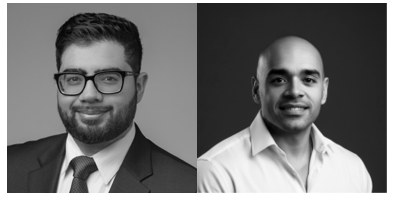
Big Red Ventures Fund Manager: Rafid Imran Patel
The following is an edited excerpt.
Rafid: I would love to hear about your journey into VC and what you have done at Galaxy Interactive thus far.
Santiago: Prior to Galaxy I was a generalist M&A banker at Evercore after receiving my MBA at Cornell. At Galaxy Interactive, I’ve helped deploy ~$20M in capital across interactive entertainment, adtech and deep tech. As an example, I’ve helped underwrite investments in the nuclear space, worked on a structured financing for a game studio, and helped underwrite our investment into a company that provides free, dual‑screen TVs funded by targeted advertising, trading the hardware for users’ consent to extensive data collection. We’ve also looked at short-form content, gamified edtech, music infra and predictive markets, to name a few. In terms of how our portfolio has evolved at Galaxy Interactive, the 2018 vintage was 80% allocated to content such as content / content adjacent companies and 20% towards infrastructure. Fund 2 is a 2021 vintage that was allocated ~50:50 content and infrastructure. The latest fund, which is a 2022 vintage is ~10:90 content and infrastructure.
Rafid: So over time there has been a shift in focus towards infrastructure, what are the drivers behind this?
Santiago: The fund’s thesis is essentially investing at the intersection of interactive entertainment, infrastructure and connected consumer experiences. The way we thought about it was: we’ll focus on interactive entertainment and in parallel, the interactive-adjacent opportunities, like a platform that adds value for content creators. Then, we focused on infrastructure, which is the tech and power layer that supports the application layer where content and content-adjacent opportunities sit. Because we were endemic investors for media and infra, the consideration we had was about how can we be involved to support portcos we have, explore potential synergies between our investments, and stay true to our overall thesis. Even though we don’t focus on the hardware layer, power has emerged as an area that is critical in our portfolio, as it is a key component to the whole AI Revolution we’re currently experiencing. A simple way to think about it is: Power <> Compute Capacity <> Content / Content Adjacencies
Beyond traditional infra players, there are new entrants looking to revolutionize how we approach power given the increased demand in overall compute capacity. This is why we invested in a couple of companies in the nuclear space, for example: one that manufactures, owns and operates Small Modular Reactors, and another one that is developing commercially viable fusion power plants. This is just an example of how our portfolio construction has shifted over time and adapted to major macroeconomic shifts.
Rafid: There is of course still some investment in content in your newest fund, what are you looking at on that front?
Santiago: Game studios are largely just a wait and see for now. Unless it’s a mobile game, traditional video game studios (PC and Console) are a tough business to crack not only given the hypercompetitive nature of the market, but also given the overall competition for consumer attention and engagement. As a result of this, and other idiosyncratic reasons, exits have not really materialized in the cadence that investors initially underwrote. A lot of investors who deployed capital in the bull run from 2020 to 2021 are stuck with a lot of equity and not many exits. Mobile, on the other hand, has been a attractive space, given their near frictionless user acquisition, distribution, and access to a massive global audience via handheld devices (Supercell, Skillz, King, and Playtika are a couple of notable examples).
Rafid: Moving on to how you think about investments in these spaces, what founder traits or operational metrics do you consider essential when evaluating investments. How do you evaluate operational viability and advise founders on runway and growth?
Santiago: First thing is, it helps when the management team has a track record. Second, do they have product market fit, and who are the competitors you’re working against. Do you have guidance that is a category killer. Next is: how does the business model work.
We start with a set of assumptions and compare against incumbents to see if the assumptions are very aggressive. Things like how you attract customers, keep customers, MAUs, etc. Are the valuations based on assumptions believable; if not, adjust down. If they’re not able to get organic users with K factor virality, then they need to invest in a performance marketing strategy, and that can be very expensive; so instead of 70M MAUs at scale, a more plausible scenario might be 15M. As a result, the investor mindset adjusts to reflect what might be achievable from a risk / return profile.
From a SaaS perspective, it’s: how do you attract users, CAC, and how do you minimize churn. Sometimes churn is minimized by design such as high switching costs, like if your platform can regularly integrate with all the other functional teams (if it’s a backend service) or ease of integration with other platforms a potential customer currently uses. And then the only thing to ensure stickiness is good customer service and making sure the product is constantly evolving as customer needs evolve.
Rafid: Shifting to more macro effects on investing, I was wondering have higher interest rates and persistent uncertainty in the macro environment shaped your investment pacing and methodology and if so how?
Santiago: From a content perspective, it doesn’t really affect it for us in a major way, since the companies we evaluate typically sell digital IP (games, shows, apps, etc), rather than physical good crossing borders. However, indirect exposure to tariffs is present, if for instance, distribution channels or marketing costs are impacted, but that would be second order. Regarding interest rates, given that the majority of the funding is equity, rate risk may materialize in valuation or cost of equity, rather than directly in their own P&L.
Where macro matters more is on the infrastructure side, particularly in areas like nuclear. There, the diligence starts with: what’s the moat, how are you developing the technology, and what’s the approach versus incumbents. We also look at whether there’s a regulatory moat, favorable contracting dynamics, or the ability to benefit from government grants. Those factors can make underwriting a check more straightforward.
Then it becomes very dependent on the asset and manufacturing footprint. If you’re building a plant, interest rates matter directly. These deals often involve SPVs with an op co/hold co structure, and financing terms can drive outcomes. For large-scale developers, you also have to underwrite supply chain exposure. Where parts are coming from and how tariffs increase costs, which then feeds into lending and project economics. Other questions such as if the team has capital, secured supply, and can execute against the business plan, and if rates come down over the next few years, do you have more confidence the business can withstand the environment. In that context, “amend and extend” strategies can come into play.
Rafid: In that same vein, liquidity seems fairly constrained in the form of exits, especially through IPOs and the secondary market seems to be hot. I was curious to learn more about your perspective and how you are navigating this shift
Santiago: The secondary market is hot as long as you have equity in demand. If you hold xAI, OpenAI, etc., or you have a position in defense tech, yes there’s demand. If you have a position in game studios, you aren’t really going to have a lot of demand. There is definitely liquidity, but it’s pocketed and siloed to specific companies or industries that are experiencing a lot of growth and demand.
For us, we still have time, since the majority of our funds don’t sunset for at least 7 years or so. But we’re always looking at liquidity opportunities, and when you underwrite a potential opportunity, you have to know how you plan to exit from the investment and what the exit landscape looks like; whether that’s real or believable. If you invested in something more esoteric, liquidity options may not be as broad. And if you’re stuck with companies that took too long to scale, pivoted many times, and need additional capital, then investors may have to be willing to take dilution as these companies raise additional capital to keep going.
Rafid: Are there any sectors you feel are heating up or structurally undervalued going into 2026 beyond just AI? Any trends you’re excited to watch this coming year?
Santiago: On the AI side, we should be careful in discerning actual moat since many companies employ AI wrappers hoping for the AI valuation uplift. Data provenance is usually important to evaluate.
On the content side, short form content is actually very exciting, as TikTok proved that audiences are attracted to short-bursts of entertainment, are engaged, and heavily ad-monetizable. As a result, there are companies that are doing really cool things leveraging that playbook.
At the intersection of content and AI, IP owners seem to have stopped being combative and are starting to ease into AI adoption with licensing deals with LLMs (Disney <> OAI / Sora deal comes to mind). As a result, content / music <> AI for UGC opportunities and adjacencies would be interesting to look at.