
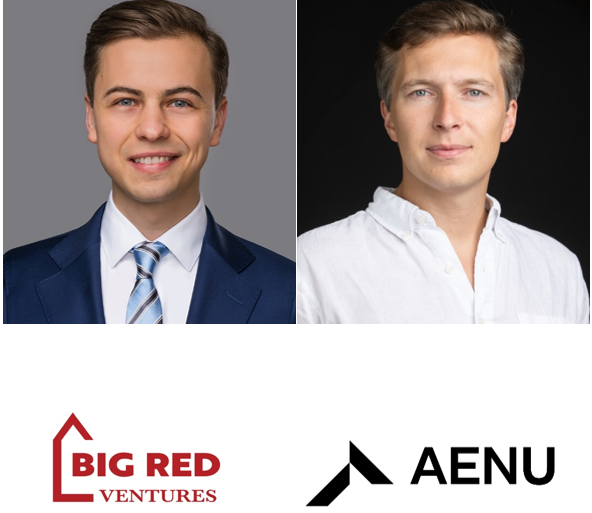
Lukas Wendt, Fund Manager at Big Red Ventures, interviewed Leo Allgoewer, Impact Investor at AENU, in December 2025.
Big Red Ventures Fund Manager: Lukas Wendt
Lukas: Hi Leo, good to have you. Let’s jump right into it. What is your current view on clean tech investments?
Leo: It’s great to be here and thanks for having me. Climate-tech remains an important and trending topic, but we can feel the narrative shift toward AI and defense. Geopolitical tensions and breakthroughs in foundational models are capturing a lot of the immediate attention and capital.
For a while, everyone wanted to do climate. Now, many talents are looking to build something in defense or AI, as that is where the money is flowing. But for us, this isn’t bad news only. The tourists have left and while the volume of equity investments into climate tech has decreased, the quality of deals has gone up. The filters are sharper and founders are more serious about solving the real problems of climate change. That said, we deeply believe that the long-term trend for climate tech investment remains very positive.
Lukas: What is your investment focus? What do you look for in a team?
Leo: We focus on startups within the broader climate space at Seed or Series A stage with preferred ticket sizes between €2–3 million. We focus on finding great founders within the fields of energy transition, industrial decarbonisation, and the carbon economy. Many of the teams we see are recent graduates: technically brilliant, but often with limited commercial experience or focus. That’s not necessarily a problem, as we look for teams that are intentional about the problem they are solving and have clarity of thought. We want founders who can bridge the gap between engineering and commercial execution – those who can translate strong technical insight into a viable business model and route to market.
Lukas: Why are investments in clean tech going down?
Leo: The answer is complex but in short, this comes down to a capital shift to the current focus topics, namely defense and AI. Additionally, investors are prioritizing short-term liquidity and software margins over long-term industrial bets. Structurally, most clean tech ventures are still CAPEX-heavy with long roadmaps to revenues, making them tough fits within the current investment theses. Furthermore, a lot of clean tech innovation was grant-supported, and as grants dry up, the pipeline thins. There is also a capital stack problem: many clean tech projects fall between venture and infrastructure finance. To bridge the gap, they need blended models combining VC and strategic capital. That’s an area where the ecosystem still needs to mature.
Lukas: What are the key opportunity areas you are focused on?
Leo: We like the industrial edge of the energy transition. Carbon removal remains interesting but is facing some headwinds currently. Energy flexibility is another core theme. Companies like Entrix are a perfect example, as they are building software layers that manage, optimize, and monetize large-scale batteries.
We also see the grid as a critical bottleneck in enabling a green energy transition. The transition requires massive infrastructure buildouts, but utilities and grid operators move slowly, and pilot projects often take years to convert into commercial contracts. Consequently, we look for companies that can shorten that cycle or bypass it entirely, like virtual power plants, or companies that optimize energy consumption in buildings. In short, companies that create grid stability without waiting for new cables to be laid.
Lukas: How do you think about driving circularity?
Leo: We like circularity and have made one investment in a company called re.solution aiming to innovate textile recycling, but there’s far more to it. We look at the space through an impact lens, investing where the damage to the ecosystem from sourcing components is high. Metals and cement are classic examples as their sourcing and production processes consume large amounts of energy. Nevertheless, technical challenges remain, especially regarding cost parity with virgin materials. It is also worth mentioning the ongoing trend of strengthening local supply chains, increasing sovereign production, and political independence. With many materials becoming increasingly scarce, we continue to observe the space closely.
Lukas: What’s your take on Food and Agritech?
Leo: We like the Agritech space and have made investments there. We are aware of the challenges like longer sales cycles and lower margins, but the space fits our conviction in the carbon economy, the energy transition, and systemic resilience. A prime example is our investment in feld.energy, which enables dual land use by installing solar arrays on agricultural land. This protects crops while producing green electricity, perfectly aligning with our core strengths.
We do also like the food space as a whole. However, certain areas like deep food science are not our core competency, and we remain disciplined in only investing in fields we understand thoroughly. We apply this discipline to adjacent areas too, for example, when we explored the data center buildout space and realized that this is more of an infra play, not a VC play.
Lukas: How do you source and evaluate opportunities?
Leo: We build our investment theses proactively. We start with a problem, like the power grid being a bottleneck, and then we go out and hunt for the solution. Of course it’s not that simple – we conduct deep dives to understand the market dynamics, break it down into segments, and identify where the real value lies. Once we have that prepared mind, we look for founders who match the profile. A key output of these deep dives is a market map, which guides our search for the right founders. We then go out and actively seek founders or startups that match our thesis. That often means discovering founders through networks, industry events, or even by tracking traction on GitHub. It’s a very network-driven business: we talk to everyone. We pursue strong deals and pass along those that aren’t a fit. Pre-seed VCs are great partners too, as they lead early rounds, surface interesting opportunities, and are not directly competing with us.
Lukas: What’s your view on the battery space?
Leo: It’s a very interesting space, but we believe the fundamental hardware battle has largely been decided. China is driving hardware costs down, and Lithium-ion will likely remain the standard chemistry for the foreseeable future as it has twenty years of optimization behind it. While we keep an eye on sodium-ion and solid-state, we don’t expect an immediate displacement.
With manufacturing being concentrated in China, we see the value in operational, optimization, and software layers. This is why we invested in Entrix, which maximizes battery asset returns through optimized operations and trading. It also plays into the macro trend of technological sovereignty as Europe wants to control the software that runs its critical infrastructure. In battery recycling, Voltfang is a good example, repurposing old automotive batteries for second-life use.
Looking at the space broadly, we like all energy flexibility plays. It’s not just about large-scale batteries but also distributed energy assets like heat pumps that can stabilize the grid and generate revenues. One example is aggregators that bundle these assets into so-called virtual power plants. In short, we look for companies that make existing infrastructure last longer, operate smarter, or unlock new revenue streams.
Lukas: Thank you for your time, Leo. Let’s catch up again before Christmas.