
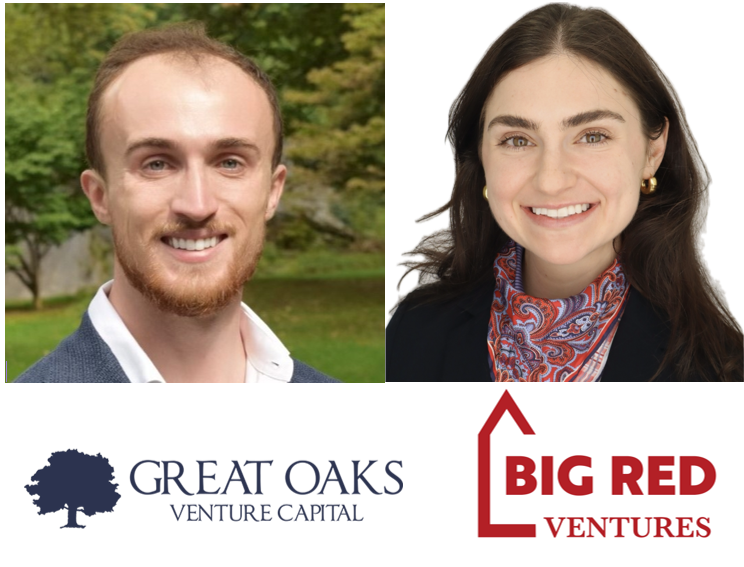
Madison: Good morning. Thanks so much for taking the time to meet with me about your experience at Great Oaks VC and the venture capital landscape.
Stuart: Good morning to you too, and of course.
Madison: Let’s begin then! I’d love to hear about how you got to Great Oaks and how your undergrad education propelled you into this environment.
Stuart: So I originally interned at Great Oaks during undergrad between my sophomore and junior year. The internship specifically put us at portfolio companies to offer support and get an understanding for the startup environment. After graduation, Great Oaks actually wasn’t hiring, so I went into consulting for about a year, and I reached back out to see if I could be a consultant for portfolio companies at Great Oaks. And so for my first two years as a full-time hire, I really spent most of my time on-site with portfolio companies and providing operational support. I helped talk about product strategy, I met with possible clients and did other networking tasks. I used that as a jump-off point to get exposure to venture capital. I was able to sit in on investment calls and help represent the firm. I transitioned to the investment team in 2019 and I’ve been fully on that team since then.
Madison: That’s an awesome path into the realm of venture capital! I’m looking forward to consulting after my time concludes at Big Red Ventures. What was most compelling about venture capital as you were consulting and as you were on the operations team? What prompted you to move to the investment side?
Stuart: Honestly, I have always really liked new technologies and innovative, small companies. I feel that one can have a lot of impact when dealing with something that is in its earliest stages. When a company becomes more established, each individual person can only affect so much. And so for me, this was a great intersection, especially since Great Oaks focuses on pre-seed and seed stage investments. We’re really dealing with companies when they’re one to five people. And so I felt that I was able to have a very high impact and I wanted to pursue a career centered around that.
Madison: Absolutely. That actually is a great segue to talk about pre-seed and seed investments; Big Red Ventures is a pre-seed and seed fund as well, and we are also a generalist fund, along with being a student-run VC fund. Great Oaks VC is a generalist firm, do you have any industries of focus?
Stuart: We are a true generalist firm, although if you name a certain industry, we likely have some exposure through a portfolio company. But the primary focus is on pre-seed and seed-stage companies who are based in the US. I’m happy to be more specific if needed.
Madison: I was going to say, yes, I’d like to hear specifically about how Great Oaks operates as a generalist firm in a very varied fund landscape. New York has a number of strong generalist VC firms, and I’ve also seen a rise in niche firms or targeted firms where they focus on a specific founder archetype or industry. Have you noticed any interactions or trends in New York City with VC firms that are generalist versus targeted?
Stuart: You know, it’s hard to say if there are real trends. I think there is a marketing angle involved as well as the breakdown of investors. We as generalists are free to invest everywhere, but if someone is raising a fund that is coming from a more specific investor base, they may have their own goals and interests, and are probably focused on investing where they see a lot of fund alignment.
Madison: I’ve asked this question to a few people recently and I think it’s across the board with fund structure and type right now, there are so many more operating VC firms right now compared to a decade ago. I’d like to hear about when you are looking into a startup, or researching for market valuation and the startup idea itself, what is something during your diligence that you do to make sure that you’re thorough?
Stuart: Without going too into the details of specifically what we do, one of the things I’ve found useful as of late is actually trying to figure out how I can be using AI to make myself better as a VC. Typically, I’m suspect of having it perform research on my behalf, and I am always sure to manually fact check and do my own work. But I found it’s been very helpful to generate helpful questions for me to then go and research myself. I try to prompt it to offer an ideal and comprehensive list of questions or possible angles to research.
Madison: Of course.
Stuart: At the earliest stages, one is always a little more data limited than with more established companies. And I have found that diligence is much more focused on the market landscape and potential customer profiles. And a lot of research to understand new technologies.
Madison: Yes, and I’m sure you screen a lot of really compelling or promising startups at GOVC, what details do you think matter most when you’re looking at an early stage startup? To clarify, what is that factor that a founder has to have or that a company has to have that makes you really interested in moving forward with diligence?
Stuart: I think immediately about the founders themselves and their own grittiness and tenacity. Especially at the pre-seed and seed stage, we’re typically in a company’s first round of financing, and the team may consist only of the founders, maybe one or two other employees. So it’s really about asking, “do these people have the expertise or some unique factor that helps them stand out?” And importantly, I ask myself, “are they the kind of person who’s going to roll with the punches, so to speak?” Over a startup’s journey, there are always numerous setbacks, changes and pivots, and I always try to see if this person seems like they are the one who’s going to stick through all of those events.
Madison: Absolutely. I’m really interested in founder chemistry, too, and I think this really is important for diligence because, as we have seen in the startup world, crazy things happen! And when friction or challenges happen, one has to be confident in their founding team to tackle it. Speaking of company changes, do you think “pivoting” is as common as it used to be or is it becoming more and more common?
Stuart: This is an anecdotal answer, I haven’t looked at the statistics on this, but I would say I have seen an increase in the pivots or at least companies that have had to pivot in the past. I think part of that is everyone adapting to the AI-present landscape and just how much it’s changing. Even three years ago is a different world with respect to our AI usage and its capabilities. And I think especially if you’re a founder, you need to be on top of it and
paying attention to upcoming changes. But if there’s a new ‘adverse’ reaction to pivots, I frankly don’t think so, at least not at the earliest stages of company development. Maybe as a company advances, those sentiments change. But when finding product-market fit and growing into the correct market, I remind founders that their business is going to be pivoting, and who they might think their initial customer is may not actually be the best kind of customer. Founders will need to be able to adapt as they advance. I would be surprised if most companies have never had some kind of pivot in their founding and development journey.
Madison: I’m with you there, I spoke with someone that actually ended up spinning a startup out of the Cornell Tech runway program, and he told me that when he first birthed the idea of his company, the current company is actually only about 5% of what his initial idea first was. And he said, “you have to be prepared for large changes like that, and when you’re thinking about starting a company, it can and will change pretty dramatically in a short amount of time, and it can still be a huge success even if there’s just one little shred of detail that is in line with the original idea you had.” I think that’s a cool way to consider a company’s definition of success.
Stuart: Yes, and to add on to that point, I agree that founders have to move in the direction of whatever aspect of their company they see is working. As they gain initial positive feedback, it’s in their best interest to go in that direction.
Madison: I just thought about how in some cases, when one thinks about the question, “what is working?” I think that there are actually fewer things that are “working now” for startups because everything is more difficult to defend in practice with the rise of AI complexity and its high bandwidth. We should definitely talk about AI in the landscape.
Stuart: Happy to discuss AI.
Madison: This is just my opinion, but what I’m seeing in practice right now, we are able to build an idea out in about 10 seconds that would have taken 9-12 months to do five years ago. And that’s very exciting to see, all of this forward movement, but it can be a little discouraging when someone is trying to build a product and we all know that other people are likely building it at the same time. Let’s talk about how AI companies have been recently building and what you see that’s been working in this environment. How does one solidify their moat?
Stuart: This is a really big point of discussion right now across the industry. And I think the jury is still out on this topic. If there was an obvious playbook on how to build a moat in the current environment, people would be using that playbook.
Madison: Yep I agree.
Stuart: In some ways, as much as things change, it’s obviously now faster and easier to build a minimum viable product. If building something like that took you about three weeks to do, then it can probably take anyone else three weeks to build that same minimum viable product. With that in mind, some aspects encourage us to go back to the basics a little bit, specifically with the questions: “What is unique about you as the founding team that is able to avoid the surrounding noise? Do you have connections to customers? Do you have insight because of your own past experiences working in an industry?” Just because someone can replicate a technology quickly doesn’t mean that a company is perfectly replicable. I like to ask founders, “what about you and what you’re building is not replicable? What is unique to you? That special detail about the founding team has always been the case. Founders have always had to assume that there might be fast followers and ensure that they are able to articulate how they stand out.
Madison: Of course, I think it is definitely still doable, and I share the same opinion on the domain expertise and power of network effects. A quick follow-on question to that, do network effects remain important in this new startup landscape? Do you see that leg-up with having a strong network growing increasingly important when vetting companies as opposed to just having an MVP or having a product built? I know that that’s changed with the increase in pivots.
Stuart: Network effects are hard to replicate and also to quantify. I think certain industries and businesses find the value and importance of one’s network to be high. I’ve always found, especially at the early stage, that network effects can be a double-edged sword, because until you have a strong network and some credibility pull, then the network itself can actually work against you as a founder. At least at the earliest stages, I’ve always thought about the following questions for founders: “what value are you adding before that network effect takes place? Does your product and your offering have an intrinsic value even when you only have one customer?” And if it does, then, I think it can be said that a founder and their company may be in a good place to build. But I think if a company requires a strong network presence to scale, the question then becomes: “what’s unique about you as a founder to bring in whatever that class of customers is?”
Madison: That is a great thought exercise to confirm that the right founders are leading in the right spaces. Stuart, thank you so much for your time today!
Stuart: Thank you, take care.