
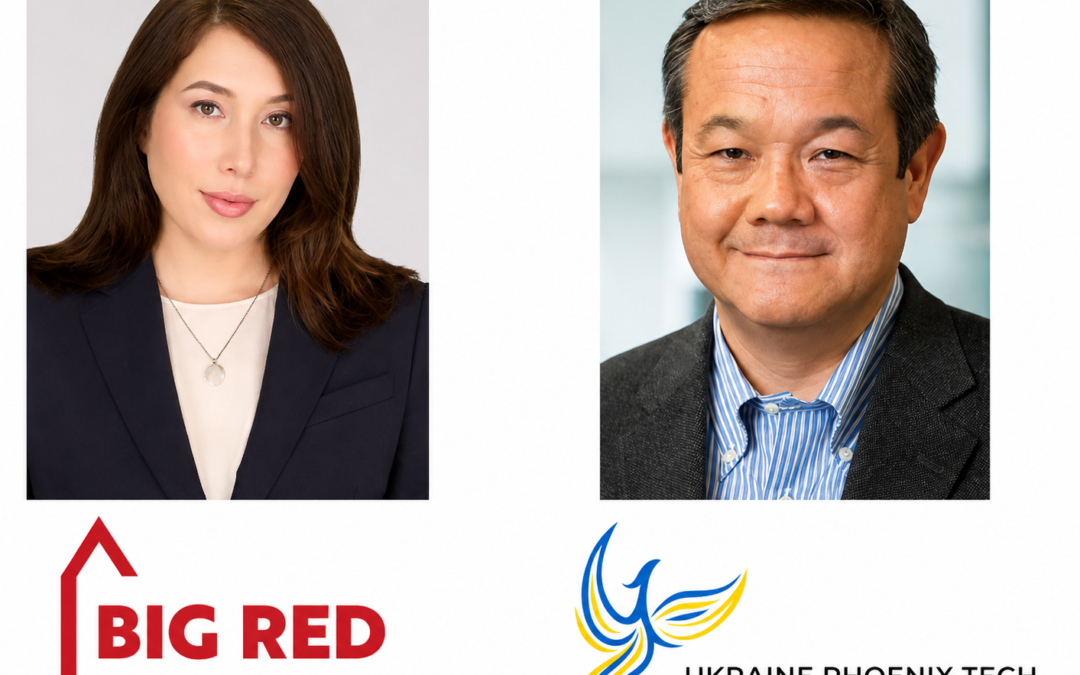
Charles K. Whitehead is the Myron C. Taylor Alumni Professor of Business Law at Cornell Law School and the Founding Director of the Law, Technology & Entrepreneurship program at Cornell Tech in New York City. At Cornell Law School, he teaches Securities Regulation, Business Organizations, and Mergers & Acquisitions, drawing on his extensive experience in law and finance. Sarah Carr, BRV Fund Manager ’25-’26, sat down with him to discuss the VC fund and incubator he began building in Ukraine in 2019.
BRV: Please tell us about your background.
Whitehead: After clerking for a federal appeals judge, I started my career at a large Wall Street law firm before moving into senior legal and management roles with several multinational broker-dealers, including as a Managing Director at Nomura Securities International and Salomon Brothers. Later, I moved to the business side and became an investment banker, a chief operating officer, the head of a large commercial banking business, and the country head for Citigroup Japan. I had a chance to see the finance industry as both a lawyer and a banker.
Although I was involved in a number of VC-related deals, as both a lawyer and a banker, the Ukraine Phoenix Tech Fund is the first VC fund I helped build from scratch. The Fund is being launched with my French-American partner, Dominique Piotet, who has substantial experience as a startup entrepreneur, including in Ukraine, as well as with partners and staff in Ukraine. The Fund is devoted exclusively to investing in cutting-edge Ukrainian startups, excluding military technology. Our pipeline is in place, and now we need to finalize the legal documents.
BRV: What is the mission of your VC fund?
Whitehead: We are an impact fund in a very deliberate way. We expect to earn a strong return, but we also expect to have a strong positive effect on Ukraine’s startup and VC ecosystems. The standard is “to do good by doing well.” Specifically, we want to make an impact in three ways:
First, we want to expand access to capital—and not just through the Fund. The Fund itself is relatively small at €50 million, although it is the largest early-stage VC fund in Ukraine’s history. Among other things, we want to attract other private capital to invest side-by-side with us.
For example, if you are an investor sitting in Chicago and looking at Ukraine today, you may think, “This looks interesting—but it’s seven, eight time zones away. I am not sure I can monitor what’s going on. I’m not sure I’m comfortable sending my money there.” If we have already invested, however, that same investor can take some comfort from the fact that we vetted the company, have skin in the game, and will continue to monitor performance. In that way, we’re a Good Housekeeping seal. We have a Western-style approach to venture investing, which should give international investors more comfort investing alongside us. In one sense, we want to encourage potentially competing VC funds to come into the Ukrainian market, get comfortable with Ukraine, and start making their own investments.
Second, we want to help the economy evolve, particularly with reference to global corporate governance and ESG standards. Ukraine has an unfortunate reputation for corruption. There are corruption issues, no doubt, but our experience is that this is much less true in the startup world, which tends to include younger people—a new generation that grew up looking to the West after the Soviet Union collapsed. Their thinking is much more American and Western European than that of earlier generations, and so they are more inclined to do business in a way that international investors would expect. Now they need the support and training to develop stronger corporate governance and to understand and address ESG matters.
This is important not just because it’s the right thing to do, but also because it will attract more capital and make the economy more efficient. To achieve this, we will hold our portfolio companies to Western standards of governance, which we think they can meet with the right guidance and support.
Third, we want to build a strong market-based economy. Historically, if you looked at Ukraine, the two main industries were mining and agriculture. Ukraine was the breadbasket of Eastern Europe, and still is to some extent. Much of the mining activity, however, took place in contested areas where the fighting is concentrated. And a large part of the country’s agricultural sector has had to deal with landmines and missile strikes that make growing and harvesting crops more difficult. This is not to say that mining and agriculture will not continue to be important, but increasingly, tech has become a major part of the economy—most recently, military technology. The world is quite focused on Ukrainian mil-tech. Even though we are not a mil-tech fund, we expect that focus to extend to startups that are not developing military products. The point is that Ukraine’s tech sector is increasingly an engine of economic growth, much more so than it was even five years ago.
Because my focus is on economic and social impact, I have done this work pro bono.
BRV: Tell us about eō Business Incubators.
Whitehead: The Fund has a sister company, eō Business Incubators, which I started in 2019 before Russia’s full-scale invasion. Why eō “Business” Incubators and not eō Incubators? Because in Ukrainian and Russian, if you say “incubator,” many people think you’re raising chickens. The incubator was launched to show that Ukrainian startups can compete globally with the right training and mentoring. For the Fund, eō is a de-risking device. It is a way for us to learn about startups before making an investment decision, and for startups to become stronger. By putting a company into the incubator, we quickly learn how strong the team and the business are. The people involved in the incubator come from around the world, including Europe, Asia, and Cornell. Felix Litvinsky here at Cornell, for example, has been a critical part of this process. We can put good businesses into eō, make them stronger, and then invest in them.
What we do not do is promise investment. If you go into the incubator, you are not guaranteed funding. However, you can be sure that we will be a lot more comfortable investing in businesses that have been through the eō program. Still, the Fund remains open to all companies, both in and outside of the incubator.
eō has been around since 2019, a relatively short period of time. Even now, following Russia’s full-scale invasion, the incubator remains active—but it has had to modify its program in light of the ongoing fighting and bombing. Nevertheless, on an unrealized, pro forma basis, the estimated IRR for our incubator is over 40%—an assessment that does not reflect grant or in-kind support, but is based purely on the valuations assigned by third-party investors at the time of investing in one of our graduates. We have had over 150 companies graduate from the incubator. Unsurprisingly, eō’s track record—as preliminary as it is—was one reason investors took note of the Fund.
BRV: What does your deal pipeline and infrastructure look like?
Whitehead: We have a strong network across Ukraine’s tech sector. Based on connections by the Fund’s partners, our ties across the country, the incubator, and inbound founders who hear about the Fund, we have a very strong pipeline.
First, of course, we have a website. We receive inquiries there, and sometimes people contact me or one of my partners directly. Second, we meet entrepreneurs at different events. Third, because the Fund is the largest early-stage VC in Ukraine, entrepreneurs know about us through word of mouth.
We expect to continue growing our staff, bringing in junior professionals with the expectation that they will become the next generation of partners for follow-on funds.
To give you one sense of the Fund’s focus on impact, by some estimates roughly 30% of entrepreneurs in Ukraine are women, yet less than 10% of women are involved in venture capital or other types of investing, even though some women are already senior leaders in the industry. We think it is important to increase the number of women involved in startup-related finance, so we focus in particular on bringing in junior staff who are women, with the expectation that they will learn, grow, and become partners over time.
BRV: What is attractive about investing in Ukraine?
Whitehead: My first deal in Silicon Valley was before Amazon was there. Not much was around. In the morning, you could see fog rolling in off the hills in the distance. Even then, with the right lens, you got a pretty good idea of how Silicon Valley would evolve and grow. Ukraine has most of the same components—the people, the technology, the creativity—to build a Silicon Valley-type ecosystem for startups. The war has slowed that trajectory, but Ukraine’s entrepreneurs remain active, even in bomb shelters, and the industry is coming back.
Historically, Ukraine has been starved for capital, even though it has been very entrepreneurial. Before the war, global entrepreneurship studies regularly placed Ukraine in the top 5%, out of 160 countries, for innovation and entrepreneurial activity. Yet, because of the capital desert, Ukrainian entrepreneurs often needed to leave the country. Grammarly, for example, is a Ukrainian-led startup. Because capital was so limited, its founders raised significant capital in the United States. Like many startups, however, much of the coding was done in Ukraine, together with the back office, even though the front office moved to Silicon Valley. It’s not a secret that many unicorns coming out of Silicon Valley have relied on Ukrainian coders and tech infrastructure to grow.
Now, with both the Fund and eō, we have a strong platform to provide Ukrainian startups with the tools they need to grow and compete globally from Ukraine. They no longer need to leave the country to build global companies. With other private investors we expect to attract, as well as Ukraine’s growth through reconstruction after the war, we think there will be many opportunities to invest in companies that can grow and scale globally.
BRV: Why do you believe venture capital is the best tool for achieving your goals?
Whitehead: Venture capital brings capital to Ukraine, but it also brings mentorship, support, and guidance on growth—how to mature into a globally competitive company. The truth is that lots of venture capital firms talk a good game, but many do not necessarily support growth as much as they could. They make investments, sit on boards, and attend meetings, but they may or may not be as involved as they could be in strategically growing the business.
We are different, largely because Ukraine is different. Our focus is to help shape our startups into firms that Western investors will understand and want to work with. The companies we have been talking with welcome this. They know there is a gap: the way you do business in Ukraine, and the way business is taught in Ukraine, is not the way business is done in the United States. The mindset is different. Getting up that curve is something they have come to realize they need, so they value our input—both from the Fund and from eō.
BRV: What is your view on startup performance in Ukraine versus the United States?
Whitehead: We will invest up to Series B, but the bulk of our investments will be in seed and pre-seed businesses. In that world, people often talk about a roughly 90-95% failure rate in the United States—in other words, a 5-10% success rate.
I have not done a formal study, but based on our experience with eō, there appears to be closer to a 25-30% success rate in Ukraine. Why does the success rate appear higher in Ukraine? I suppose there are a number of reasons, but I think one of them relates to how new startups are viewed in Ukraine. In the United States, if you tell your parents, “I’m going to do a startup,” they might be a little concerned, but at least they’ll know what a startup is. They may say, “You’re young, so why not? Go give it a shot.” If you tell your parents your startup plans in Ukraine, you may get a very different reaction. Tech startups are not yet an accepted career path. And what that means is that, as an entrepreneur in Ukraine, you must really want to pursue this path to start up your own business. Less committed entrepreneurs wash out. That is one reason why, by the time a startup gets to eō, the success rate appears higher.
What the Fund is trying to do is help create a sustainable, 21st-century small- and medium-sized business environment that gives people greater economic independence because they are building their own businesses. They are not reliant on the government or some pre-existing large business, and that gives them more freedom in what they want to do. Done right, we are helping build a generation of entrepreneurs who will have greater flexibility and greater freedom to pursue what they want to do.
BRV: Do you think your project has advanced a shift in mindset in Ukraine?
Whitehead: In 1991, when the Soviet Union fell, there were a number of attempts to bring American- and Western-style business practices to the former Soviet republics. The American Bar Association sent over teams of lawyers who went up and down Eastern Europe and Russia, basically working to adapt local laws to U.S. standards. In fact, you will sometimes come across corporate codes that look remarkably like those in the United States, because that was the model they were using. The problem was that simply transplanting black letter law to another country does not really work unless you understand the local context in which you are trying to implement those rules. For example, although Ukraine has a concept of fiduciary duty, it bears only a limited resemblance to what we have in the United States, notwithstanding that the concept was modeled on U.S. corporate codes. It’s an example, at best, of an incomplete legal transplant.
The same is true when you’re talking about business transplants. It is one thing to say we’re going to introduce an American-style incubator into Ukraine; it’s quite another to actually implement it. To be successful, we had to experiment to find what worked and what needed to be modified.
The same is true with the Fund. It is a Western-style fund, but no doubt some things will need to be adapted in dealing locally with Ukrainian startups. For example, regarding ESG, we expect there will need to be a significant educational process. If the Fund simply told entrepreneurs, “Everyone does ESG; you should, too,” you might get cosmetic attempts at complying with these standards, but no real acceptance within the industry. To address this, we need to make clear that there is value—beyond simply adapting ESG itself—if Ukrainian startups implement these standards. Global investors will likely be more comfortable investing in firms that have implemented real ESG practices, and this needs to be explained. In other words, startups need to understand that implementing these requirements is part of what is needed to scale into a global business. In that context, it makes much more sense for an entrepreneur—even at a relatively early stage—to begin implementing ESG requirements.
BRV: What has been challenging about launching the Fund?
Whitehead: Well, in general terms, think about starting an early-stage venture capital fund as a first-time fund manager. That’s challenging by itself. Now, think about starting that fund in an emerging market—that adds a whole new level of risk and issues that need to be dealt with. And an emerging market that is post-Soviet has even more challenges, including perceptions of corruption. And, oh, by the way, add that the country is also in a war. As you can imagine, this was not an easy fund to raise.
Another problem we encountered—and this may sound odd—was that, with some investors, a €50 million fund was more difficult to raise than, say, a €500 million fund. From an investor’s perspective, the returns on a €50 million fund are likely to be far less than the potential returns on a €500 million fund, even though the oversight burden is roughly the same, particularly in a country like Ukraine. So, for some investors, it maybe made sense not to invest at all. Early on, a few investors told me, “It’s too bad the Fund is only raising €50 million. If it were a couple hundred million euros, I could look at you, but I do not have the bandwidth to invest in a small €50 million fund.”
The fact is that it made no sense for us to raise more than €50 million. Ukraine’s tech economy—as strong as it is—is still relatively small. I think it will grow quite substantially, particularly as capital begins to flow into the country, but that will be a matter for a follow-on fund.
BRV: Do you have an investment thesis or priority areas you are focusing on for investment?
Whitehead: We are agnostic as to technology, except that we will not invest in military technology, in line with EU restrictions. We are fortunate to have strong European investors. They are restricted, however, from investing in military technologies. Our principal thesis is to make sure there is a strong positive impact on Ukraine and its economy—providing opportunities for growth within Ukraine, while recognizing that many of these businesses will also have staff and sales in Europe or the United States.
BRV:Do any U.S. regulations govern your activities in Ukraine?
Whitehead: Because we are not currently marketing to U.S.-based investors, U.S. securities law issues are limited, although some requirements will still apply, principally because I am in the United States. At the moment, we have no U.S.-based investors.
BRV: Are there any applicable regulations in Ukraine?
Whitehead: Our fund is based in Luxembourg, and all of our LPs are located outside Ukraine. So, as currently structured, we are not generally subject to Ukraine’s investment advisory laws. That would change if we were to solicit Ukrainian investors or open offices in Ukraine, but that is not something we are planning to do at the moment. It bears noting that, even though a significant portion of our portfolio companies’ operations will be in Ukraine, the entities we invest in will generally be organized outside Ukraine. That is because Ukraine’s corporate law does not yet provide sufficient protections for minority investors. So our portfolio companies will need to incorporate outside Ukraine—such as in Delaware or a Western European jurisdiction.
BRV: What attracted your interest to Ukraine?
Whitehead: My dad was an American diplomat, and so part of my childhood was in the Soviet Union. In fact, I visited Ukraine when it was still a Soviet republic. I was also the first American to go to a young Communist “Pioneer” camp in Crimea, called “Artek.” The camp was intended for top students from across the country, but in many cases, the children were simply relatives of senior Communist Party members. So it was basically me and 8,000 young Communists. If you ever want to steer a young American toward a career on Wall Street, put them into a young Communist camp with 8,000 Pioneers for six weeks.
Years later, I was guest lecturing in the Ph.D. program on law and finance at Goethe University in Frankfurt when a group of Ukrainian lawyers asked me to come to Ukraine to lecture. They were surprised when I said yes.
I first arrived in Ukraine just after the Maidan Revolution in 2014, about 10 days after they pulled down the Lenin statue in Kharkiv, where I was visiting. Even at that early stage, you could begin to see a transformation.
After a few visits, academics, businesspeople, and regulators in Ukraine came to understand that I had practiced as a lawyer and banker before becoming a law professor—and they asked me to help bring capital into the country. Kharkiv, in particular, was Ukraine’s primary academic center, and so there was an interest in finding ways to commercialize the technology being developed across more than 100 universities, colleges, and research institutes.
Up to that point, Ukraine did not have a lot of experience with incubators. Even though Ukraine had over 100 of them, none of them had real world experience bringing new businesses into a global market. And there was also a limited understanding of venture capital. Many early-stage investors in Ukraine demanded 51% of the company they invested in, not fully appreciating the problems that this created for both entrepreneurs and potential later investors. The good news is that the understanding is beginning to evolve and, with the Fund, we expect to begin to see an investment platform similar to what you would see in Western Europe and the United States.
BRV: Keep us updated on your efforts. Thank you for a wonderful conversation.