
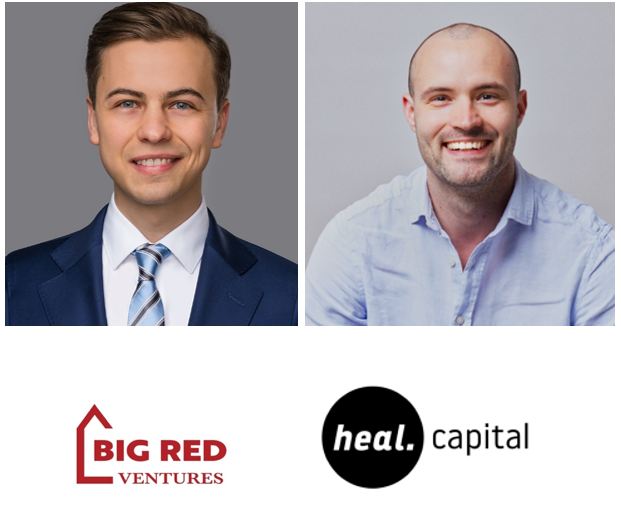
Big Red Ventures Fund Manager: Lukas Wendt
BRV: Lucas, let’s start with the macro picture. How would you describe the current fundraising environment for healthtech startups?
Lucas: The market has slowed down noticeably. You can feel it in dealflow conversations, in the time rounds take to close, and in how founders talk to each other. There’s this informal grapevine among founders. “Don’t go out to raise in July,” they’ll say, and then everyone goes out at the same time anyway because the windows feel so narrow. Bottom line, you should allow sufficient time for fundraising. Unless you’re in the top 0.1% of AI companies, those are being flooded with money and at high valuations… it’s a binary environment at the moment.
BRV: You recently published an analysis on your Substack reacting to Anthropic’s labor market impact report, specifically through a healthcare lens. What was the key takeaway?
Lucas: Anthropic built a metric comparing theoretical LLM capability against observed real-world usage across job categories. Healthcare scored high on theoretical capability, above 0.6 for practitioners on a zero-to-one scale, but very low on actual observed usage, under 0.2. The question is why, because other surveys show great AI adoption in hospitals. My explanation: Part of it is genuinely low adoption, but part of it is also that Anthropic’s data only reflects Claude usage. Based on the latest public data, Claude has maybe three percent physician market share versus ChatGPT’s fifteen-plus percent. So the data might have a blind spot.
BRV: What makes healthcare fundamentally different from other industries when it comes to AI disruption?
Lucas: Three things protect healthcare jobs disproportionately. First, the O-Ring effect. Healthcare bundles diagnosis, physical examination, treatment decisions, and patient interaction into one inseparable role. You can’t just automate one piece and replace the person. If you automate documentation, the doctor just has more time for the physical exam. Second, regulation. The Anthropic paper’s own example is telling: “authorize drug refills” is rated as fully exposed theoretically, yet has essentially zero observed AI usage. The theoretical-to-actual gap closes far slower in healthcare. Third, there’s a physical floor. Support staff, the people plugging in IVs, handing out medication, carrying equipment, they’re the physical glue holding the system together, and even the most bullish robotics founders admit autonomous humanoids are five to ten years away from replacing high-risk physical tasks.
BRV: You went further and built your own analysis using Heal Capital’s dealflow data. What did you find?
Lucas: I wanted to see if startup activity could serve as a proxy for where AI is actually impacting healthcare jobs. More real-life impact should attract more startups, right? We’ve screened over 8,000 startups at Heal Capital, and about 1,779 of them mentioned AI-based products or services. I mapped each startup’s description to healthcare tasks from the O’NET database and rolled that up to 22 occupation groups. The result is a heatmap of theoretical AI capability versus startup activity. Health IT and medical coding are heavily targeted, as are complementary medicine and primary care. All of those are communication- and documentation-heavy fields. On the other end, anesthesiology and surgery look safest, which makes sense given the physical complexity. An interesting finding was that nutrition medicine and pharmacy showed high AI feasibility but low startup activity. Could be a market opportunity?
BRV: You made a provocative point about future career advice. Can you elaborate?
Lucas: If these trends hold, jobs that traditionally had lower status, because they involved more “dull” physical work, will survive AI the longest. In an extreme scenario, knowledge-heavy specialties like internal medicine could effectively be degraded to support roles, where humans conduct physical tasks based on an AI’s commands. So, half-jokingly, you might want to tell your kids to become nurses or pharmacy technicians rather than internal medicine doctors.
BRV: Let’s talk consumer health. Everyone’s building health apps, but are people actually using them?
Lucas: Honestly, no. No health app has truly solved the engagement problem. They all churn heavily. The companies in the strongest position are wearable brands like Whoop and Oura, because the hardware gives you a clear, recurring reason to open the app. You paid for the device, it’s on your wrist, there’s a tangible data loop. Beyond that, possibly ChatGPT itself is becoming a health engagement platform by accident. People are dumping their life stories, their mental health struggles, their symptoms into it. It’s not a health app, but it’s capturing health behavior. And with their recent “ChatGPT Health” launch, OpenAI is doubling down on this trend.
BRV: So what would it take to build a consumer health “super app”?
Lucas: Very few companies can build a super app from scratch. It almost never works. What works is a single, viral use case that pulls users in, and then you expand from there. That’s what I’m actively looking for, a viral use case outside of wearables. Food scanning is one avenue I find promising. MyFitnessPal still dominates calorie tracking but have just acquired food scanning app Cal AI, so they’ve clearly bought into this trend. The question is always whether someone can build a consumer health experience that’s so frictionless and so satisfying that it becomes the entry point for a broader health platform.
BRV: What’s the most surprising company or concept you’ve come across recently?
Lucas: There’s a team building a meeting notetaker, but for patients at the doctor’s office. That’s the reverse of how we usually think about clinical documentation. Normally, it’s the doctor using ambient AI for their notes. This flips it: the patient walks into the appointment, the app listens, and afterwards the patient has their own structured record of what was discussed. They’re now going viral in their home country, the Netherlands. The brilliant part is that over time this passively creates a patient-generated health record. Not only with wearable data – like most other apps – but based on actual medical interactions. That data opens all sorts of doors: You could handle clinic appointments, insurance questions and actively steer patients through the system. It’s an Uno Reverse Card on clinical AI.
BRV: How about the US insurance space? That seems like a massive opportunity but notoriously hard to crack.
Lucas: US health insurance complexity is a genuine market opportunity. The system is almost intentionally opaque, costs are unpredictable, plans are hard to understand, and navigating prior authorizations is a full-time job. The US loves middlemen, and AI loves disrupting them. But where do you start? I’ve been thinking about fertility as an entry point. It’s emotionally charged, mostly out-of-pocket, and people are desperate to optimize both the clinical pathway and the financial one. I’ve seen a company building an AI layer specifically for fertility cost optimization and treatment timing. The emotional intensity means users are highly engaged, and the out-of-pocket nature means you bypass the usual insurance billing nightmares.
BRV: Your 2026 predictions put voice AI front and center. Why?
Lucas: Voice automation is where the money is right now. The economics are incredibly compelling because you’re directly replacing human labor, call center staff, front-desk workers, appointment schedulers. And the technology is finally good enough. Even large enterprises like Allianz announce they’re rolling out AI call centers. This sort of adoption unlocks massive VC funding, startups raise 5-10m rounds with just a few signed customers. I know at least two startups who pivoted from their original product into voice bots for clinics, just because it’s such a hot market. Good companies hit one million euros or more in revenue run rate within months.
BRV: In your Heal Capital team predictions for 2026, your colleague Felix mentioned that voice AI might show “upside cracks.” What does that mean?
Lucas: Felix’s point is nuanced. Speech and transcription are becoming commodity technologies. Scribes were first product category in the AI wave and are now embedded in medical records and billing workflows. There’s some stickiness in that. Front-office and outbound voice startups, while the tech keeps improving, now need to build the same relevance and stickiness. My underlying assumption is that scribes, billing, and AI front-office companies will all converge into one market. So the new AI voice companies will need to prove they’re relevant enough.
BRV: You also wrote that the top two or three voice AI winners in European healthcare will be crowned this year. Who’s in the running?
Lucas: There are many great companies. I’m personally watching Praxipal, Vocca, Mindoo, and Tucuvi closely. Similar to scribes, these companies will follow a land-and-expand playbook, so early funding heavily skews the odds. I assume whoever gets distribution fastest in 2026 will likely lock up the market. That’s why I said the prediction isn’t really about whether voice AI as a product succeeds, it’s about who wins.
BRV: One of the recurring themes on your Substack is the tension between big tech platforms and healthtech startups. OpenAI launched healthcare products, and you wrote that this is “just a warmup.” How worried should founders be?
Lucas: They should be thoughtful, not panicked. OpenAI entering healthcare is a massive signal that the market is attractive, that’s validating for everyone. But their launch was more ChatGPT-with-health-data-in-the-background than a fundamentally new product. The real question is what comes next. I think they’ll try to connect patients and physicians directly in the app to create network effects. At the time of the launch, over 80 percent of LLM users were on ChatGPT, and probably half of doctors. If OpenAI gets both sides pushing each other’s adoption, that’s very hard to compete with. Unless they keep screwing up PR and trust… looking at the Anthropic and DoW debacle.
BRV: But history suggests big tech healthcare launches don’t last. You referenced data showing a median of just 3.4 years before shutdown or divestiture for projects like IBM Watson Health, Google Health, Amazon Care.
Lucas: That’s a valid concern. Organic healthcare launches by big tech have a disappointing track record. But this time might be different because LLMs are genuinely closer to healthcare’s core need, which is managing, retrieving, and synthesizing medical knowledge, than any previous big tech capability was. A small advantage for European startups is that regulatory moats and data privacy requirements will buy them time, especially since OpenAI features tend to launch in the EU with significant delays.
BRV: What does defensibility look like for a healthtech startup in this environment?
Lucas: It’s not about the AI performance anymore, that’s becoming commoditized. Defensibility comes from workflow integration, proprietary data, and distribution. If you’re embedded in a hospital’s EHR, or you’ve built deep integrations with national health systems, that’s a moat OpenAI can’t replicate overnight. European companies actually have an advantage here because healthcare systems are nationally fragmented — the regulatory and integration work to serve the German market is completely different from France or the Netherlands. But in the end, fast execution and traction is your best moat.
BRV: Let’s close with Heal Capital’s investment focus. Where are you deploying capital?
Lucas: AI automation in healthcare is a core focus, for all the reasons we discussed. The economics are clear and the adoption curves are steep. We’re also excited about surgery tech making a comeback. To quote my colleague Felix: after years of startups gravitating toward lightweight admin tools, the surgical workflow, including pre-op and post-op, is re-emerging as one of the most attractive places to build. Large, well-defined workflows, real economic gravity, strong links to outcomes and billing. We’ve signed one deal in this space and have a second in the making.
BRV: What about neurotech? Seems like there’s a lot of buzz.
Lucas: Neuro is genuinely hard to assess from a tech VC standpoint. The teams tend to be excellent, but the teams often struggle to find attractive business models. The regulatory complexity is immense, the development timelines are long, and the commercial pathways are uncertain. It’s one of those areas where we’ve invested and watch closely but have recently been careful.
BRV: And hardware or medtech more broadly?
Lucas: Less of a focus for us. Long R&D cycles, unclear returns, and it’s hard to reach venture-scale outcomes. Our partner Christian has been transparent about this, diagnostic devices, for instance, are generally in his “no-go” category. We prefer areas where the cycle from deployment to revenue is shorter and more predictable. Admin-focused AI, voice, documentation, workflow automation, that’s where we see the fastest path to real traction.
BRV: One more thing, you screened over 2,000 new companies last year alone. What’s something founders consistently get wrong in your dealflow?
Lucas: The biggest mistake is not understanding their investors’ heuristics. Every VC partner has go and no-go areas that aren’t fully evidence-based, they’re pattern-recognition shortcuts built on anecdotal data. If your company sits in an investor’s “burnt” category, even amazing traction won’t change their mind. It’s almost pointless to argue after a decline. The smartest founders research their target investors deeply and self-select into conversations where there’s genuine thesis alignment. It saves everyone time and dramatically increases conversion rates.
BRV: Lucas, this has been incredibly insightful. Thanks for taking the time.
Lucas: Thanks, Lukas. Always happy to talk. And for anyone interested in going deeper on any of these topics, check out Healthtech Off The Record on Substack, I publish weekly and it’s all human-written, I promise.