
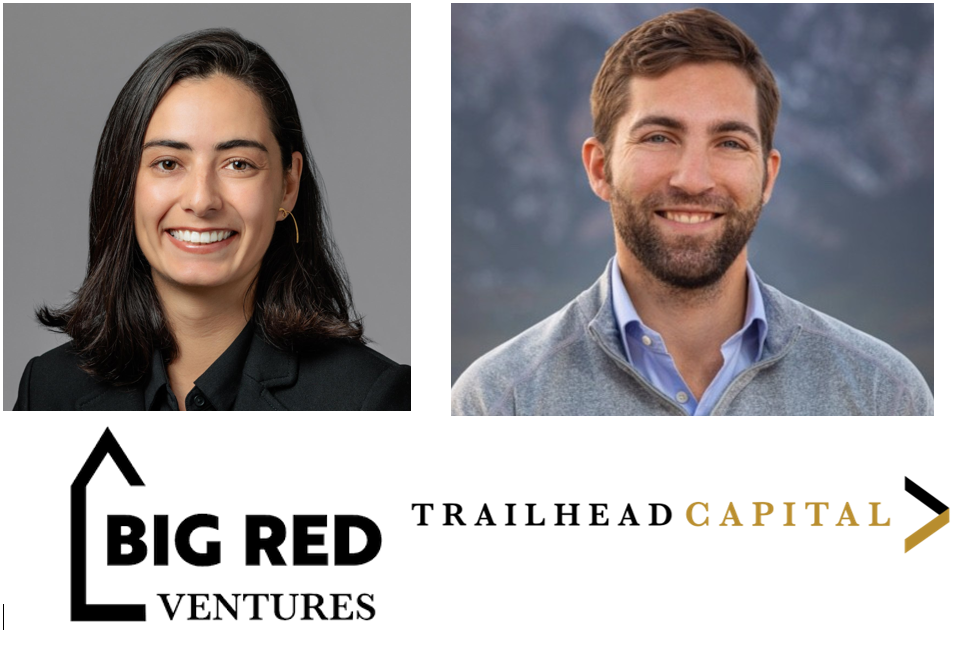
A Conversation between Nick Schroer, Partner at Trailhead Capital and Mariana Ferreira, Fund Manager, BRV.
Mariana Ferreira: To get us started, can you walk me through your path? What led you to Trailhead, and what were the key inflection points in your journey that brought you to a VC fund focused on regenerative capital?
Nick Schroer: I knew I wanted to go into the food and agriculture space. I studied ag and applied economics in college at the University of Georgia and, through internships and such, thought that would lead me more into the real assets direction—farmland funds, forestry funds, timber REITs, etc.
In college, I met a guy who ended up hiring me right out of school. He had a legacy grain brokerage business with offices in, I think at that point, 11 or 12 countries and 15 or 16 total offices. He was moving physical grain supplies via his brokerage network—Brazil to China or Egypt, wherever. I thought it was an interesting business he’d built since the 80s, but I didn’t go to work for that business. I ended up working for him directly.
It was a pseudo–family office. He wanted to use that network to do personal and alternative investing in the food and ag space. I thought to myself, sure I’ll be underpaid and I’ll have no idea what’s going on, but ultimately I can look at opportunities and do deals. In effect, I could skip ahead in building my investor skills, learn how to build some trend analysis and market mapping in my own head. I worked for him for a number of years, doing anything from small South American grain deals to living in Colombia while we were buying an avocado company. I did some work in Mexico, and he did a bit of startup investing as well in the ag space, and that’s how I got a taste for VC. That’s why I say I’m an accidental venture capitalist.
Three or so years into this, I understood that these are long-term, illiquid, private equity–style investments and that’s not scalable operationally. I came to my mentor/boss and explained that he was either going to have to keep paying me out of pocket, fire me, or bring on some partners and institutionalize this. Luckily, he agreed and found the partners who now make up Trailhead Capital.
That 2020 relationship ended up with us raising a first fund of 50 million in 2021. Our Fund I was a 2021 vintage. I was effectively grandfathered into that fund. I’m an accidental VC, and I like it a lot. It’s a great job.
Mariana Ferreira: And beyond him, who else makes up the LP base for Fund I? Who was interested in this regenerative thesis?
Nick Schroer: There was a bit of tension originally in how the LP base was curated, specifically because there’s an impact tinge to it—but we, as fund managers, don’t look at this as concessionary capital at all. A pure financial investor should see this as a good opportunity as well.
From an LP base standpoint, as we were building to the final close, it started with “family and friends”. It’s a food and ag systems transformation thesis centered around regenerative agriculture, and that was really appealing to a lot of folks. As we continued, we got more attention from institutions. By the end of the fundraise we had the Rockefeller Foundation, a small endowment, a number of fund-of-funds, and single‑family offices.
Mariana Ferreira: Let’s get into that thesis. How do you describe where you invest and what you’re looking for?
Nick Schroer: There are a number of schools of thought when it comes to system change. You have everybody from “blow up the system and make a new one” to “incremental change is good enough.” We’re somewhere in between. For one, we’re constrained by the nature of being venture capital investors. We can’t necessarily invest in everything we might thematically agree with. It might be too small, too capital‑intensive, the wrong geography, the wrong growth path, not relevant, timelines off—there are a lot of disqualifying factors for companies that are really cool to build. That’s the architectural constraint on portfolio construction.
Then thematically: what does it actually look like? What is our theory of change? What’s the point of all this? The tagline is: using innovation and technology to improve human and planetary health. There’s an incremental implication there, which plays into the investment verticals.
Practically what this strategy looks like is making an investment. Ascribe is a great example. It’s a Cornell spin‑out from the Boyce Thompson Institute. They have small‑molecule technology that essentially primes plant immune systems for pathogen pressure. There’s no hit to yield. You’re providing an off‑ramp from a traditional chemical fungicide. That’s cool for us because there’s a huge profit opportunity for a large industry incumbent to buy a business like this, and it’s in their best profit motive to do so.
Ultimately, when it comes to M&A transaction math, it’s “Is this accretive to the bottom line?” We want to invest in companies that are ultimately going to get bought for their financial merits while the product they’re bringing to market has outsized impact.
Mariana Ferreira: Yes, Ascribe is a great example because these companies can’t just flip their entire chemical businesses overnight. They need credible “what’s next” paths in their businesses.
Nick Schroer: Yes, and you’re looking at the impact on farmers, too. If you’re Big Ag co making glyphosate and it gets outlawed, that’s a hit to your bottom line, but it hurts the farmers more. Now they don’t have an alternative for weed control.
So you have to work within an ag system that exists, but provide undeniable alternatives that are not just less damaging but environmentally regenerative. Something that builds soil health, increases water‑holding capacity, innovations that can actually be investable, sold, marketed.
Mariana Ferreira: That’s a great example, can you share another investment that shows the range of what Trailhead Capital backs?
Nick Schroer: If we zoom out, Fund I has basically two big buckets. The first is production‑related stuff—Ascribe falls in there. You’ve got irrigation technologies, robotics businesses, novel chemistry, farm‑management software platforms, etc. The second bucket is outside the farm gate—more middle‑of‑the‑supply‑chain opportunities. That’s really relevant because you have a completely different universe of company buyers. Your exit universe is far bigger and more expansive in the middle of the supply chain. You could have, say, an operating‑loan fintech company that exits to a financial sponsor with a banking thesis, rather than just a typical ag incumbent for a couple hundred million dollars.
Within those buckets, I’ll give another upstream, first‑bucket example, because it’s fun. One of our original investments was in a company called Vence – an electric collar company for cows.
Before electric collar technology, ranchers had to have a real fence because the technology didn’t exist. Then you move to laying down a little wire that communicates with the collar to shock. You don’t want to shock them unnecessarily, but they learn pretty quickly. And now modern collars are geofenced.
Vence takes this idea of geofencing which exists for domestic pets (mainly dogs) and takes it to cattle. Operations doing pasture grazing where you have connectivity issues and geographic challenges to putting up fences can greatly benefit from this. Rangers won’t fence 200,000 hectares, so what can we do? Now, they can geofence with Vence collars.We sold the business to Merck Animal Health in 2022.
It mattered to us not only because it’s a highly excitable business but also because you can enable intensive rotational grazing—which is amazing for building soil health and increasing outcomes for ranchers while decreasing costs. It was a pretty crazy revenue multiple on that sale within 15 or 18 months.
Mariana Ferreira: That is an inspiring story! Agriculture is so broad—food, biologicals, hardware, finance. That often comes with cyclicality. How do you think about that at Trailhead?
Nick Schroer: There’s something tricky we don’t talk about enough in agriculture: when we talk about “big‑A agriculture,” we’re really talking about commodity row‑crop ag. Of course there’s going to be cyclicality in commodity businesses, and I’d put cattle in that conversation. It’s countercyclical right now, but it’s still cyclical.
There are pockets where you don’t experience the same type of cyclicality, though. You have the California produce environment—that’s a pretty different unit‑economic and macroeconomic picture than Midwest corn and soybeans. You have cattle in the middle of the country. You have timber and forestry elsewhere. You have fiber opportunities, etc. These are international markets.
I tend to think we have very small exposure to commodity cyclicality and the risks there. One, because half of our portfolio is outside the farm gate. There’s connectivity, but it’s not immediately related to commodity pricing. Two, with the upstream opportunities, there are very few businesses we invest in that ultimately sell directly to farmers. It’s always a tricky business model to specifically market a product to farmers. The products get to farmers, but often through agronomy groups, retailers, distributors.
It’s tricky. You certainly see it now—three, four, five years in a row of really horrible commodity outcomes—and that weighs more on the exit landscape than on the startups. The startups should be countercyclical and/or multi‑cycle resilient. In VC, we have a ten‑year time horizon, give or take another couple of years. If the corporate bottom line of the company that’s going to buy these startups has taken a huge hit, they’re not going to buy a startup for a little while. We’ve seen a slowdown in the M&A space—not in the number of companies getting bought, but in the headline number of good companies getting bought for real prices.
Mariana Ferreira: Let’s shift to the founder lens. You’ve seen a lot of teams and companies. What patterns do you see in teams that scale well?
Nick Schroer: As I’ve thought more about the space and underwriting deals, I can’t tell you with certainty what’s going to win—I’m not an oracle—but I have a much better sense of what’s going to lose when I see it.
You can almost flip the question: what’s going to lose? I don’t know if you’ve seen the “idiot graph.” On the left is the guy who knows nothing: “It’s all about team and TAM. Is the team good, and is the TAM big enough?” Then in the middle of the bell curve it’s like, “We’re doing crazy amounts of underwriting, going into unit economics, looking at all sorts of stuff.” And then on the far right side is the Yoda‑type figure who says, “It’s all about team and TAM.”
Beyond the humor, there’s something to that. I would say a key skill is having capital‑raising ability. That’s a hard truth for founders to hear, because their product might be better than a competitor’s, but if the competitor can raise money, it doesn’t matter—they will go out of business. Capital is oxygen to startups.
Capital formation is huge, which is why a lot of venture capitalists are lemmings. We want to follow other VCs into a round. It’s not because we can’t think for ourselves, rather because if a cap table is strong and this company gets into trouble, we’ll be able to form an extension round or a bridge without going out of business. What does that do? It buys you time. And what does time do? It buys you success. That’s one of the more important things.
There’s no magic bullet. It’s about capital formation and understanding that VCs can’t invest in everything. VCs love infinitely scalable and ultra‑high gross margin businesses. There are a lot of companies I see that have relatively high capital needs and CapEx. If you’re not hyperscale, accept that you’re not that and look for the right pool of capital.
The things we would invest in that aren’t that are potential biotech solutions and some really cool hard tech—but those are few and far between, and there are reasons we do them. We understand the capital needs and the scale potential.
So a key lesson is: go where the money is. Don’t spend time banging on the doors of non‑relevant capital pools. I’m personally learning this on the LP fundraising side as well.
Mariana Ferreira: Many of our readers are also curious about working in VC themselves. What should they double down on to become strong investors?
Nick Schroer: I’ll give you this advice because it’s advice I give myself a lot: have an opinion. But instead of just having an opinion, spend time forming the right opinion.
Anybody can learn Excel. Anyone in your MBA program is smart enough to learn the nuts‑and‑bolts tasks. Anybody can learn the legal work, build an underwriting model, do portfolio construction, understand the technology—not that those things are trivial, but they’re learnable.
What makes a good VC, in my view, is the “what if” thing—the “why.” It’s a combination of curiosity and following that curiosity to a real opinion. That real opinion leads to a view on what, when, why, and where you should invest. Spending time thinking about what you believe and why, will allow you to have conversations with funds in a way that’s actually additive, instead of just, “Hey, do you have an internship or a job?” I want to hear what’s interesting to you and why. What is your view on this space? You know we invest in this area—ask me a question I haven’t thought of before. That’ll pique my interest.
Mariana Ferreira: I love that framing—not just having an opinion but really forming it and getting curious. There’s a lot of strategic thinking work in that. Well, thank you so much for your time.