
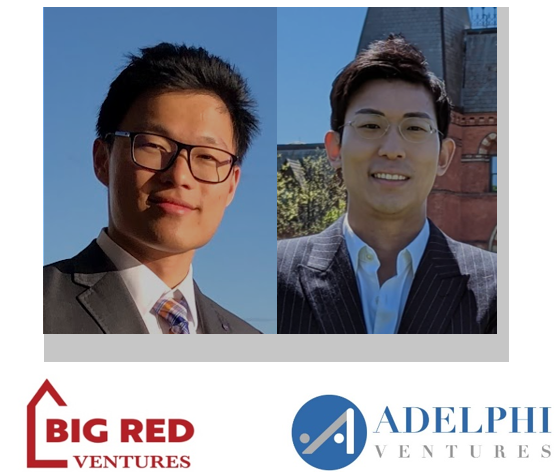
Big Red Ventures Fund Manager: Marshall Qian
Marshall: What drew you to venture capital, and when did you realize that it’s something you wanted to do?
David: For me, venture capital was a natural evolution rather than a sudden shift. I started out on the operating side, building and scaling ventures across the biotech and consumer sectors. Over time, I found myself most energized by the intersection of strategy, capital, and execution.
When I was leading cross-border initiatives between the U.S. and Korea, I kept seeing great technologies and founders who were stuck between ecosystems. They had strong science but struggled with market entry or funding narratives. That’s what really drew me into venture capital, the chance to be a bridge between innovation and commercialization.
The moment I realized it was the right path came during my time at Cornell Tech, working closely with the studio teams. Working with founders, studio teams, and investors gave me a front row seat to how early-stage decisions shape long-term outcomes. That is when I realized I wanted to be on the side that helps founders think strategically about those first hundred days. Not just writing checks, but helping them align business models, regulatory strategies, and investor expectations from the start.
Marshall: What is the main investing philosophy at Adelphi? Are you focused on biotech? Are you focused on Korea?
David: At Adelphi Ventures, we focus mainly on cross-border deep tech and biotech, especially where data and biology intersect. A lot of what we do connects U.S. and Korea innovation ecosystems but not only focused on Korea. We also work with China and other regions. We’re helping founders scale technologies like AI-driven diagnostics or computational drug discovery across both markets.
For example, for some of our portfolio companies, we helped them with their clinical validation, regulatory planning, and partnership with pharma or hospital networks. These companies have great technology and innovative solutions, but they are not as great at commercialization. That is why we support them not only with funding but also with commercialization strategies.
Personally, I’m really excited about anything that sits at the intersection of AI and life science. Things like digital pathology, spatialomics, or predictive biology. That’s where I think the next wave of global healthcare breakthroughs will come from.
Marshall: What other benefits or opportunities are there, specifically for biotech from Korea to enter the U.S. besides the capital they can get? What is the biggest benefit for doing so? And why not Europe or another market?
David: Beyond the capital, the U.S. offers three big advantages for Korea-based biotech: validation, velocity, and value capture.
First, validation. The FDA is located in the United States. FDA approval via programs like Breakthrough Designation or Fast Track signals global quality and helps with partnering everywhere. KOL networks in top trial centers can generate publishable, decision-grade data faster.
Second is velocity. The U.S. has a dense, founder-oriented ecosystem. Business development teams at big pharma, CROs, CMOs, and payers are accessible in one market. That shortens the cycle from preclinical to first-in-human, from proof of concept to partnership.
Third is value capture. The reimbursement upside and deep public markets on the NASDAQ create better liquidity and licensing terms when you hit milestones. Those are the three big advantages for not only Korea-based biotechs, but all biotechs outside of the U.S.
Europe can be excellent for certain indications and hospital-based studies. But heterogeneous HTA reimbursement and multi-country trials can make decisions slow. If your thesis needs rapid proof of concept, payer willingness to pay, and pharma business development density, the U.S. is usually the faster route to non-dilutive partnerships and premium deal terms.
Marshall: What is your broader view on the VC landscape right now, and what is your suggestion for somebody like me or my classmates in general to go into the VC space?
David: First, every VC focuses on AI-driven everything. Every business model has AI in front of it. The second thing is fundraising is still very tight. New VC funds are raising at the lowest annual total since 2017. Every new venture capital firm finds fundraising so hard right now.
The third thing is exits. The exit landscape is less frozen, but not fluid. The U.S. IPO window is honestly more active than 2024, but venture-backed liquidity is uneven right now. Many managers rely on secondaries or continuation vehicles to bridge to later exits.
The takeaway I think is a bubble market. AI and AI-enabled companies can raise quickly. Everyone else must show capital efficiency and creative milestone design. Cross-border, for example Korea to U.S., is attractive where it accelerates clinical and business development proof and reimbursement clarity. But if you’re not showing the possibility or the clinical or business development proof, then it should be a little bit hard.
Venture capital wants to see money-driven or proof-of-concept validated business models. That is what venture capital wants to see right now. Because it’s so hard to fundraise now, older venture capital firms are clearly more cautious about investing money into startup companies right now.
Marshall: When you have these cross-border companies, is the goal IPO, or do you also try to get them acquired by larger companies like Johnson & Johnson or Moderna?
David: That’s a really good question. IPO is just one path, not the only path. For cross-border biotech, we optimize for optionality. We run a dual track, so we are credible for IPO and attractive for M&A or major partnership.
We formed partnerships with leading companies like Johnson & Johnson, Moderna, and AstraZeneca. One of our invested companies has a partnership with a larger firm. They gave us great feedback, and we’re re-raising and building up the partnership from that point. Then, they think about how our company can fit into their business model or how our technology can boost their portfolio, then they’re thinking about acquiring.
We could think about structured partnerships with asset spin-out with upfront plus milestones for the big pharma. Then, they’re thinking about acquiring the technology or company itself.
When would we push IPO? If the company is a platform with multi-asset depth and repeatable data generation, then public markets can fund a pipeline. If it’s a single asset or tool with a strong strategic fit, then M&A could be more attractive.
Marshall: What’s a word of recommendation or a tip you would give for MBA students right now looking into this field?
David: For MBA students getting into venture capital, first, pick a lane that’s narrow enough to matter. Say, AI and pathology for tech tools, and become visibly useful in it.
Second, prove you can source. Build a small pipeline, do founder calls, and produce three to five one-page investment memos that show your problem understanding.
Third, create immediate value. Help two to three startups. Lend a design partner intro, PI-KOL connection, or help scope U.S. regulatory or reimbursement steps, or help them hire. Be people who help with their portfolio next Monday.
Package all that into tight portfolio artifacts: a three-to-four-page thesis memo, a pipeline tracker, and two founder references. When you meet firms, lead with your niche, your future deal flow, your diligence rubric, and how you can help post-check in week one. That will attract venture capitalists or venture capital firms.
The views expressed are solely of the speaker and do not necessarily reflect the views of Adelphi Ventures or its affiliates