
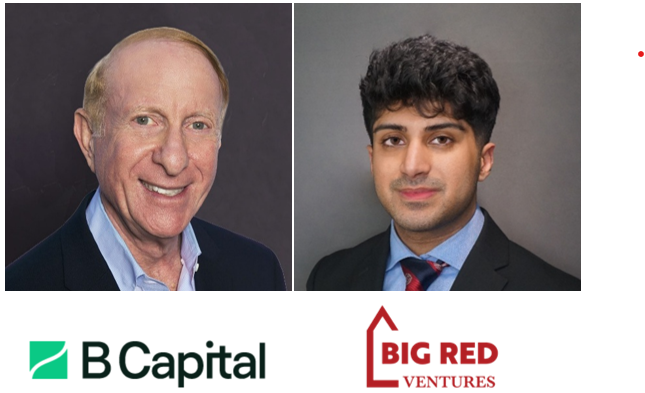
A Conversation with Howard L. Morgan, Chairman & General Partner at B Capital
Khizar: To begin, Could you share a bit about your journey after your PhD at Cornell and some of the key moments that shaped your career?
Howard: When I left Cornell, I did not really leave Cornell. I stayed as a faculty member in operations research and what became the computer science department. The computer science department at Cornell had only started in 1965, so I was one of the early people whose PhD work sat between OR and computer science, working on simulation and optimization.
I stayed at Cornell for a couple of years. My wife and I loved Ithaca, but at some point we looked around and said, “There is no city here, maybe we should find a place with a bigger city.” So I went to the University of Pennsylvania and spent about 25 years there in what was then called the Department of Management and later Decision Sciences.
At Penn, I brought ARPANET machine number 50 onto the network. We connected Penn the net and worked on what we called in the 1970s “the Office of the Future.” We were using email, early word processing, and what became the first spreadsheet programs. I really enjoyed my time at Penn.
Then in 1982, Jim Simons asked me to help start Renaissance Technologies. When we started it, Jim was CEO and I was president. We had about 70 million dollars to invest, half in quantitative strategies and half in venture. For the first seven years there was a big venture portfolio alongside the quant work. After 6 years the quant side was reliably doing something like 38 percent a year, and the venture side was more like 25 percent. So we eventually took the venture piece out of Renaissance and I did venture investing separately.
We did a company co founded by Josh Kopelman called Infonautics, which we took public. We helped build Half.com and sold it to eBay. We helped start Idealab with Bill Gross, which I am still involved with.
Later, Josh Kopelman came back to Philadelphia and said, “I want to do more investing.” We did some angel investing together and then he said, “It is time to raise a real fund.” That became First Round Capital. I thought I might do it for about ten years because I was 60 at the time, and that is roughly what happened. It was a great run. I am still a large LP in the First Round funds.
Around 2015 or 2016, Eduardo Saverin, one of the co founders of Facebook, asked me to help start B Capital. The idea was that I could do it part time. B Capital has a global mandate and a partnership with Boston Consulting Group, and that is where I spend most of my investing time now, along with chairing the Cornell Tech Council on Roosevelt Island in New York.
Khizar: You spent many years in academia before moving fully into building companies and investing. How did that transition change the way you thought about time horizons and your work?
Howard: The biggest difference is the time horizon. In the academic world we had roughly a twenty year horizon. When we were researching the Office of the Future in the 1970s, we were thinking about how people would be working in the 1990s. We were doing that work for the Navy, for DARPA, and others.
Email is a good example. At first people treated email as just an asynchronous phone call. I said, “It is a written communication. The lawyers are going to get ahold of this.” We saw that early. We put email into the White House, and that system later showed up in the Iran Contra hearings with Oliver North. That is the kind of long time frame you have in academia.
In venture capital, it is different. When you fund a company, you hope it will last for a very long time or until it goes public or gets acquired, but your job is much more immediate. The main job is advising founders on what they are doing, how they are doing it, and how they are thinking about markets, product, and organization.
One thing I have always believed is that having a strong technical background is very helpful in that work. There is nothing wrong with venture capitalists who “just” have MBAs, and we have hired some of them, but being able to understand the technology and systems at a deeper level is very useful when you are advising founders and evaluating what is really possible.
Khizar: You were working on computer networks and the early internet long before the web browser. What did that period teach you about technology waves and adoption that you see reflected again today with AI?
Howard: There are really two pieces to that story. The first is the early network era, when things grew from the early 1970s through the early 1990s. Then there is the internet era when the web browser arrived and suddenly everything became much more visible.
Cornell was ahead of the curve in a lot of ways. Cornell did some of the first video conferencing systems and had early search tools. What changed with the web is that it democratized content creation. You could create something and very quickly have the rest of the world see it.
On the infrastructure side, when we built NSFNET and expanded connectivity to more universities, you still only had a few million or maybe low tens of millions of users. Once the web came along, by 2000 you had on the order of a hundred million users, and of course today we are in the billions. The scale changed everything.
We also saw how businesses would start to take advantage of the technology. One example was electronic bill presentment and payment. Instead of mailing you a paper bill and having you write and mail a check, companies started sending you an electronic bill and then collecting payment electronically. That seems obvious now, but at the time it was a big shift, and companies that built those systems grew very quickly.
You see some of the same patterns with AI. New infrastructure gets built, costs come down, and then someone finds the business workflows where the technology really changes behavior. Adoption is not just about the technology curve, it is about understanding how people and organizations actually work.
Khizar: You have evaluated companies as a founding president of Renaissance, an early stage investor at First Round, and now at B Capital. When you look at a new venture, what do you focus on first?
Howard: There are two big things. The first is the market. How big is the market they are going after? If you have a great entrepreneur going after a very small market, that might be a perfectly good business, but it is probably not a venture capital opportunity. It will never get big enough to justify the kind of capital and risk we take. So understanding the real market size, and getting that right, is critical. If you do not get that right, there is not much else you can do.
The second piece is the entrepreneur and the leadership team. You want to ask whether this entrepreneur can grow with the company. There are people who are great at going from zero to twenty people but not great at going from twenty to two hundred. Sometimes you need to bring in another leader after two or three years.
We have seen founders who handled that well. Michael Dell brought in a very strong executive to help run Dell. At Google, the founders brought in Eric Schmidt with John Doerr’s help. Those are examples of people who were smart enough, early on, to get coaching and to bring in additional leadership.
I also look for coachability and for a real team. I would rather have a two person founding team that can bounce ideas off one another than a single hero founder who cannot be challenged. At First Round we saw that companies with diverse founding teams, including teams with a woman or someone from an underrepresented minority background, did materially better. Different points of view and perspectives matter when you are building something.
Khizar: Do you see recurring pitfalls in founder mentality that tend to make or break companies?
Howard: There are a couple of common issues. One is not understanding finance well enough. If I ask a founder, “How much cash do you have on hand and how long will it last at your current burn rate?” and they do not have a clear answer, I worry. Businesses live and die on cash. If your plan does not include a view of that, and is purely product focused, that is not usually a recipe for success.
Another issue is how founders handle bad news. I tell people I want to hear the bad news first, because then I can help you fix it. There is a tendency, especially when things are going poorly, to hide bad news. That is like an infection that grows before you can throw the antibiotic on it. It is much better to surface problems early and deal with them.
Khizar: You mentioned that venture goes through cycles. How do you think about entry price, fund math, and exits when you invest?
Howard: The industry goes through cycles where capital is scarce and cycles where capital is abundant. When capital is broadly available, which was true from the late 1970s through 1999 and again in some more recent periods, entry prices go up because there is more money chasing the same number of good opportunities.
When I started investing, a seed round might be done at one or two million dollar pre money valuations. By 2009, you could see seed rounds at six million or more. The exit prices did not go up three times over that period, they maybe doubled. So if entry prices triple and exits only double, your returns get cut roughly in half. You have to understand that dynamic.
The way you make money in venture is that a few giant hits pay for the rest of the portfolio. You do not want the rest to be zero, but most of the fund level returns will come from a small number of companies. So I require our investment team, whenever we invest in a company, to be able to show how that company could return half the fund. That implies having enough ownership at exit for the math to work.
The exit environment also changed. In the 1990s, you had small research shops and sales desks that would support 50 million dollar public companies. Stocks traded in eighths of a point, and that spread was split among the brokers, so they could afford to cover smaller names. After decimalization and after the regulatory changes around 2001, commissions went down by a factor of about one hundred. It became much harder to cover small public companies.
On top of that, Sarbanes Oxley and other rules made being public more expensive. So instead of lots of small IPOs, many exits shifted toward acquisitions by large companies like Google, Microsoft, or others. That has a very direct impact on how you think about entry price and required ownership.
Khizar: Today you are chairing B Capital. How do you describe B Capital’s role in the market and what you try to bring to founders?
Howard: B Capital’s fundamental thesis is globalization and digitization. We invest in companies that can use technology to go global quickly. Helping an entrepreneur in places like India, Singapore, or the Gulf build a company that can sell globally is a key focus for us.
Our partnership with Boston Consulting Group is central to that. One of our portfolio companies does contract management. The founder is of Indian origin and built the technology in Bangalore, with a team also in Seattle. Because of the BCG relationship, we were able to introduce that company to a dozen clients in Europe in about three months. That would never have happened otherwise.
We are mostly B2B investors selling into the Fortune 2000 or Global 2000. Through BCG, we can map markets, understand what the competition looks like, and figure out where there is white space. That gives us, and our founders, what we call a “right to win” in certain markets. When we go into a deal alongside firms like Andreessen Horowitz or Sequoia, we want to know why we specifically have the right to win and how we can help the company in ways others cannot.
Khizar: Toward the end of our conversation we talked about students and people who might want to build a career in venture. What advice do you give them?
Howard: If you think you want to become a VC at some point, there are a couple of paths. Some people come in more as founders and operators. Others come in more through the MBA route. In either case, if you can, try to get access to some capital, even small amounts, and do angel investing.
I mentored Aaron Holiday when he was at Big Red and later as he built his career. Having a track record of putting your own money into companies is very helpful. At First Round, when we looked to hire new partners, one of the things we looked at most carefully was their angel investment record. Had they put their own money, even ten thousand dollars, into friends’ companies or founders in their network? What did that portfolio look like?
It says a lot about your taste. It shows what you are willing to do when your own money is on the line. It also builds your network. At places like Stanford, and increasingly Cornell, there are alumni founding many companies. Being part of that network and seeing a lot of companies early is a huge advantage if you want to be in venture.
The real sin in venture is not turning down a good deal, it is not seeing it. Josh and I met Brian Chesky and he told us his idea for Airbnb. We went home and told our wives. They both said, in effect, “That is not happening in my house.” So we passed. It was a bad decision, but the important thing is that we saw it. If you never even see those opportunities, you do not have a chance.
*The following interview has been condensed and lightly edited for clarity while staying as close as possible to Howard’s original words.