
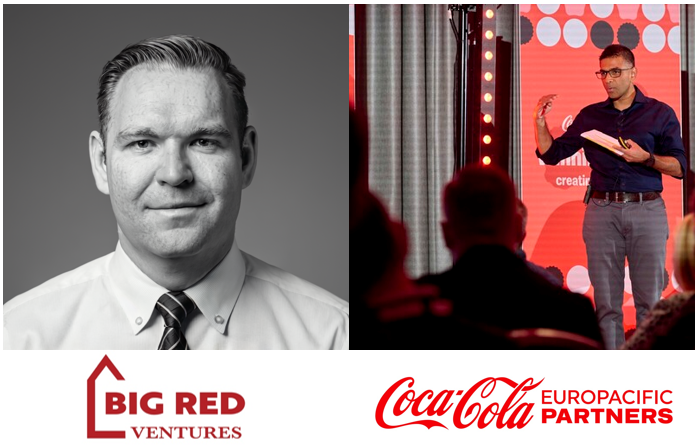
Christopher Archer a Fund Manager with Big Red Ventures, interviewed Sash Rajendra, Associate Director at Coca-Cola EUROPACIFIC PARTNERS Ventures in December 2025.
A Conversation with Sash Rajendra of Coca-Cola EUROPACIFC PARTNERS (CCEP) Ventures.
Chris: Sash, it’s really great to sit down with you, Big Red Ventures (BRV) gets superb opportunities to interview VCs, but it’s unique and different to interview a team member associated with the Venture arm of a huge corporation. What are some key differences you see between a Corporate VC fund and your ‘run of the mill’ Venture Capital entity?
Sash: CCEP Ventures is a wholly integrated part of CCEP and as such, is aligned with our strategic objectives. We are primarily focused on helping deliver our sustainability commitments, identifying, investing and supporting early stage climate tech start-ups that can support our ambition to reach Net Zero by 2040. Whilst financial performance/health is an important factor, this is our main driver.
Chris: That’s an awesome way to look at it, intriguing insights there. CCEP invests in startups just like other VCs, but I imagine you are more strategic with your investments than financial. Would it be correct to say a corporate VC is more interested in innovation and technology than a 10x or 30x return on the investment?
Sash: For us at CCEP, yes. We spend a great deal of time exploring and thoroughly evaluating the technological aspects of each startup. Understanding the USP of technology, it’s techno-economics and its potential for industrialisation form a key part of our decision making process. Time to scale is also an important factor for us. Ultimately, we always come back to the basic question: “Will this help achieve (or at least get closer) to our “Net Zero by 2040” ambition?”
Chris: I understand, I think that is a great way to look at it. What is CCEP’s investment thesis, and what is the strategy required to meet that thesis? It’s clear that sustainability is important to CCEP. Do you care to expand on how sustainability goals fit into the investment thesis and where CCEP sees itself in the future?
Sash: Sustainability is core to how we make, move, and sell our drinks and how we care for our people and communities. It’s been built into how we do business – from the ingredients and water we use, to our sites and packaging, and how our drinks reach the hands of millions of people; and that is why we are exploring new technologies and solutions every day.
Chris: Sash, do you care to share with us some of CCEP’s recent investments and maybe a key reason that made the investment a must? And maybe, if there are a few companies on the horizon that have potential?
Sash: Some of our recent investments have been in the following areas: i) Direct air capture ii) Wastewater treatment (re-use of water and energy generation) iii) Decarbonisation of industrial waste heat iv) Use of AI to improve crop yield. In terms of what’s next on the horizon, in addition to all of the above, plastics in packaging is a big focus area.
Some of our recent investments include HotGreen, who are developing ultra-efficient industrial heat pump that could allow use to further reduce emissions at our manufacturing sites; Avalo, who are using AI models to explore how we can grow the ingredients for our drinks more sustainably and AirHive who are developing energy efficient and scalable direct air capture technology that we will be trialing at one of our sites. Plastics in packaging is also a big focus area for us and we work towards making our packaging as sustainable as possible.
Chris: This one is for the Entrepreneurs out there, how do I attract a VC to what I am doing, what I am building? How do you manage your investment pipeline? Do you find that CCEP ends up investing in companies that approach it, or are most of CCEP’s investments the result of your own discovery process?
Sash: This is not an exact science! As you can imagine, we have a vast global network (both in terms of technology/R&D and investors) through the Coca–Cola system that gives us access to a large range of entrepreneurs and start-ups. The size and scale of the brand also attracts start-ups to us – so, I’d say it is a healthy mix. On the whole, it is the wider eco-system (entrepreneurs, industrial corporations, investors, academics) that come together to find the best solutions. In terms of your 1st question for the entrepreneurs, I would always ask the questions: “What problem is my technology looking/going to solve?”, “Why/how is this technology unique?” and “How can this be scaled up successfully (i.e. cost!)?”
Chris: Are you willing to share with us what are the top three things that CCEP is looking for in a startup, what is most important to garner CCEP’s support in a Seed or series A? Technology? TAM? The Team? What would you say?
Sash: We typically look in the “Pre-Seed to Seed” stage. Again, the main questions we are looking to answer are: “How solid are the technology fundamentals?”, “How successfully can this be scaled?” and “How quickly can it be scaled (sustainably)?”. In addition, a key factor in our final decision-making process involves the “culture” and “leadership” of the start-up.
Chris: This has been great! I really appreciate you sharing this insight with us. I want to thank you for your time and attention from the whole BRV team. I hope we get to talk again soon! Thanks, Sash!