
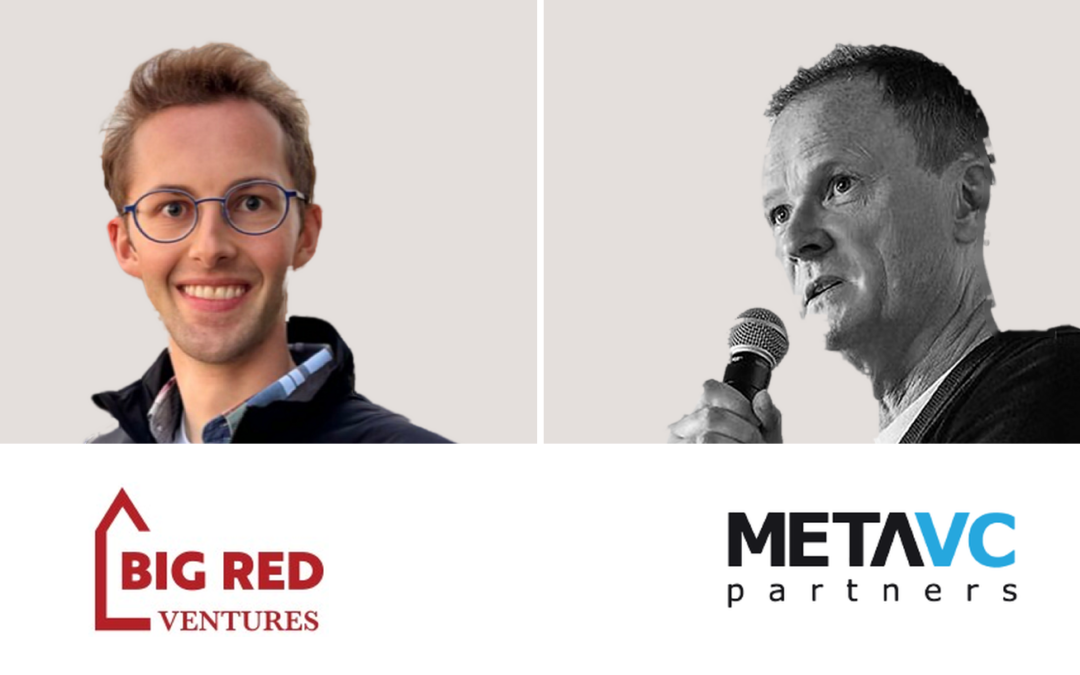
In this interview, Nicholas Behrens had the opportunity to speak with Conrad Burke, managing partner at MetaVC Partners, a Silicon Valley venture capital firm investing in metamaterials and frontier hard tech startups. Conrad studied physics in Dublin, worked in photonics and semiconductor research at NEC Central Research Labs in Japan and at AT&T, and later led a nanomaterials startup from seed through acquisition. Conrad discusses his path, his view on the solar industry, how the US and Europe compare for startups, where MetaVC sees opportunities, and what he looks for in founders.
Nicholas: I’m here today with Conrad Burke from MetaVC. He’s had a very broad background, from working in photonics and metamaterial research, to founding a company, to launching his fund, MetaVC. I’m thrilled to chat with you today and ask you some questions. First, could you share a little bit about your path from photonics research and engineering, to founding your startup, to launching your fund?
Conrad: Thanks, Nicholas. My career has been long and colorful and interesting, and up and down and sideways in many ways. I’m based today in Silicon Valley, having lived here for 22 years now. I’ve lived in the United States for over 30 years in total. But the origins of me and my career go back to Europe. I actually grew up in Ireland. I’m a graduate of physics, with an undergraduate and master’s degree in physics, applied physics, in Ireland, in Dublin: Trinity College Dublin and University College Dublin. But I spent almost my entire working career overseas. I took a job working in photonics research in Japan in the late 80s, which some of your readers may appreciate was the golden era of Japan, where the country was the number one economy, and all things “big” were happening in Japan and nowhere else. I was fortunate to work in high-speed lasers and photonics at NEC Central Research Labs. I worked on a lot of the optics that were used for high-speed transmission, both terrestrial telephone networks and undersea cables linking continents for data and for voice. I then moved to the United States with AT&T, working in semiconductors and optoelectronic devices. This was at a period when AT&T was a vertically integrated, almost monopoly, phone company, like many were at that time. We did everything from transistors and semiconductors and lasers all the way up to running a network, offering phone service and satellites, and having ships to lay cables, and everything in between. But my career was in semiconductors and optics for the most part, the physics of which was always very fascinating for me. And that’s how I started out, if you will. A lot of other things happened in the meantime, but that was the genesis of my career.
Nicholas: Thanks, Conrad. And then, what brought you to founding a startup? What shifted? What opportunity did you see? Did you feel like that had to happen?
Conrad: I think I got to the point where I needed to scratch an itch. Working for a larger company, by the way, I think is still a very worthwhile endeavor for any graduates coming out of school. You can learn a lot working in a big enterprise in terms of how you present yourself, how you deal with customers, quality, reliability, manufacturing, all the different attributes that a big company can bring. But having control of one’s destiny and doing something as a startup was something that came later in my life. I worked in two startups. The first was in MEMS optical components, a startup in San Diego, which was really enjoying the run-up in what would now be described as the dot-com era. We became a major player in the optical transport layer in communications networks. That’s the good side of things. We raised a lot of money, we had customers, we had revenue, we had products, and we had filed to go public. And we, like many companies, got caught in the whole downturn, which was sudden, rapid, and quite painful. We didn’t make it in the end. But all those learning curves and the excitement in that journey were huge advantages to starting another company later. It gets back to the famous statement you may sometimes read or hear, that you learn from your mistakes, and that was definitely the case for me in that first try. The second try was a startup which I led from seed through Series D, and which ultimately got acquired by a major Fortune 100 company, DuPont. We set it up in Sunnyvale, California. It was in silicon nanomaterials, which were used in the manufacturing of traditional crystalline silicon solar cells, which are ubiquitous in how solar panels are made today. We were fortunate to be, I think, a threat to DuPont and many other companies that were big suppliers of materials to the entire supply chain for photovoltaic solar cells and solar panels. In fact, DuPont was the largest supplier in the world. So, we became an integral part of their business through an acquisition. That was soup to nuts: building a company from scratch, building the team, the technology, the patents, and the manufacturing. And it was a very successful outcome for us and for our investors.
Nicholas: Exciting. Building on that, do you see any shifts in the solar market? It’s been highly subsidized by China, and it’s not necessarily cost-competitive to manufacture solar in the US anymore. Are there new materials or new technologies that can help the US become more competitive, or is that mostly for efficiency and not for mass production?
Conrad: That’s a good question. Two important things happened that took solar from a nascent, expensive business into an absolute worldwide juggernaut of inexpensive solar panels, which are now ubiquitous. One was in the early 2000s, when Germany, as a nation, heavily subsidized not only the production of solar supply chain equipment and solar cell manufacturing, but also the use: the economics of installing solar and getting paid for it as a consumer, whether commercial or residential. The second, and the most important thing, which happened not too long after that, was the government initiative in China to manufacture solar panels at scale. They did that so successfully that they have, frankly, probably become the de facto manufacturing factory for almost all solar panels that exist today. While that sucked the life out of production in other countries, it did result in enormous price drops, a 90%-plus drop in solar panel prices, which has allowed the use of solar to be a lot easier and ubiquitous today. In fact, the installation is probably the most expensive piece of having solar panels on your house today. It has very little to do with the cost of the solar panels. They are so cheap nowadays, and that’s a result of the two things I mentioned. But to answer your question, there is still room for technological efficiency improvements, which is really what drives down the cost overall, the cost per watt or the cost per kilowatt hour. More importantly, there is a continuous cycle of cost reduction that will not go away, and it’s incremental innovation in materials and manufacturing processes, but not a radical shift in how panels are made today, just making them cheaper and slightly better. Small efficiency gains in photonic to electrical conversion will continue, and that usually comes from materials innovation. But it’s a tough business. I don’t want to sugar-coat it by suggesting this is a great place to go invest in. It’s a difficult business to be in. Not for the shy.
Nicholas: Especially as it’s become increasingly commoditized.
Conrad: That’s right. It’s in the same category in many regards as flat panel televisions. I don’t think there’s a big drive to bring flat panel TV display manufacturing to the United States or to Europe, for example, because it’s already been concluded that that’s just an impossible task, given the commoditization of that entire sector.
Nicholas: That makes sense. I noticed your interview earlier this year with the UK Metamaterials Network. What do you see as competitive advantages for the UK, Europe, and the US? And where do you think they could improve?
Conrad: Well, I think, and it probably reflects why I want to live in the United States, and particularly in California, the capitalist system works much faster and more efficiently in the United States than anywhere I’ve seen, and I’ve lived on three major continents in my career. In my opinion, it happens faster and more efficiently in the United States than anywhere else. With that said, I think it’s difficult for Europe and for the UK, which you referenced, to compete with some of the momentum that a country like the United States has, whether it’s access to capital, labor laws, the ability to start a company, or the ability to close down a company. All those things happen more efficiently and faster, maybe more brutally, one could argue, in the United States than in those countries or that continent. Having said that, you’re right, I have spoken with and spent time with the UK Metamaterials Network, among many others, not just in the UK, but also in Europe and in Asia. To be specific, there are some really interesting and very innovative technologies coming out of the UK in metamaterials, which is an area of interest for our fund. But like many situations, the access to venture capital, and the risk-taking environment to just quit your job or leave university and start a company, is very different in the United Kingdom than it would be in the United States. And even within the United States, it varies from state to state. My comments often reflect a California, and in particular a Silicon Valley, perspective, which is not what the rest of the world looks like. But that access to capital, that risk-taking initiative, and the flexibility of labor laws all contribute, I think, to the US being faster at starting companies. And certainly, that’s reflected in the markets, even in the public markets. Every startup wants to be on the NASDAQ versus other exchanges around the world, for good reason.
Nicholas: That makes sense, and I frequently see European companies listed in Europe trading at a discount relative to similar companies trading in the US.
Conrad: That’s right.
Nicholas: You mentioned your fund focuses on metamaterials. What metamaterial applications do you currently see as the most promising over a two, five, or ten-year time horizon, in terms of both technological feasibility and future market demand?
Conrad: We like metamaterials. It’s an area we’ve invested in over two funds, my predecessor fund and this one. While our next fund will be a little bit broader than just metamaterials, there’s still a lot of life and opportunity in this whole domain of metamaterials: in computing, in communications, in medical applications, in energy, and in imaging and sensors and so forth. So, we see huge opportunities across multiple billion-dollar markets. There are a lot of different areas that get us excited. We like computing, where Moore’s Law in silicon is coming up against limitations, so there are more and more photonics applications. Metamaterials are not the answer for everything, but there are some unique areas. We have one investment, in fact, in computing, which is going to upend a lot of GPU products by using optics instead of silicon electronics. But we also see things on the other side of the spectrum, in a noiseless world with noise cancellation and acoustics. This is actually an area I’ve been quite impressed with in the UK, to backtrack to that earlier question you asked. We see a lot of very interesting intellectual property from universities in the UK in that regard. Metamaterials lend themselves to enormous opportunities in smaller, faster, cheaper devices: not necessarily creating brand new devices, although sometimes that is the case, optical computing being one, but also just taking existing products and making them better. That’s where we see a lot of opportunity.
Nicholas: That makes sense. You mentioned your next fund might be a little bit broader. As deep tech and hardware have become extraordinarily popular in the past five years on the investment side, how do you differentiate your fund? And where do you see this going next?
Conrad: Well, we like to see ourselves as a niche fund, a small, focused fund. In fact, our next fund will likely be the same size as the first fund. Our last fund was $62 million. That allows us to focus on what’s important: being in there “in the trenches,” involved with each company, helping them succeed. In terms of broadening, we like metamaterials, we like nanomaterials, we like the small-scale ability of these types of materials and structures to really go after making smaller, cheaper, faster devices. I know that’s a simplification, but that’s really what it is. As things get more mobile, and needs get more efficient and more powerful, we see some of these materials being key to making lots of new types of products that haven’t been made yet. We see no shortage of incredible technology coming out of universities, and no shortage of entrepreneurs wanting to start companies. It’s an exciting time right now, where there are so many entrepreneurs versus 25 or 30 years ago, all chasing the dream. Not all will be successful, but hugely impactful technologies are being built in universities in the US that we’d like to think we’ve got a good handle on, and maybe a first mover’s advantage on. Then it’s just getting the team around that, getting the funding and the mentoring around that, and getting companies built and going.
Nicholas: Makes sense, thanks. And then finally, where do you see the most value in the AI stack? We have frontier labs, compute and chip providers, lithography equipment manufacturers, and all the way to the energy producers. Do you think some will find it easier to capture value than others? Do you think specific parts will become more commoditized? And do you think we’ll see consolidation in those sectors going forward?
Conrad: Well, we’ll certainly see consolidation. That’s without doubt. That’s an inevitability. We like deep tech, or what some people call frontier tech or hard tech. The term that’s used the most nowadays seems to be physical AI, but by and large, they all mean the same thing. The two partners, me and my partner in MetaVC Partners, were both physics majors. We see that there’s a huge opportunity in venture capital, at least, where those that understand what’s actually going on at the physics level of some of these technologies can see through the noise and see the opportunity. That is of the utmost importance. We’re not so much enamored by technology for the sake of technology at this stage of our careers. Our goal is to make money for our investors. So we have to be efficient and judicious with our views on: Will this technology work? Can this team make it work? Can this team execute to make this a successful business? Can this successful business give a great outcome for our investors? Having said all that, we’re not software experts, so that’s not in the equation. We tend to be most interested in the difficult science and the difficult hardware, mostly at the chip level. That’s the stuff we’re most interested in. We’re not chasing climate tech and energy efficiency. Those are probably benefits that come out of some of the things we’re working on, but they wouldn’t be the leading drivers for us. We would be looking at more powerful capabilities that are smaller, faster, cheaper, and manufacturable, and that upend the incumbents existing today, whether it’s in consumer electronics, industrial equipment, robotics, drones, or computing. We look for ways to break through there and be successful. And then the last point is defensible intellectual property. We put a huge emphasis on IP, and we’ve got a lot of experience there. Having a giant moat and an IP position, whether it’s licensed, organically developed, or put together with us, is of paramount importance. It’s not the only thing that matters, but it’s up there, in parallel with doing these other things at the same time.
Nicholas: That makes sense. So: not being enamored by tech for the sake of tech, focusing on hardware, especially at the chip level, for more powerful, smaller, and cheaper devices, with environmental benefits often falling out of that, and that it’s critical to also have defensible IP.
Conrad: Absolutely. And then, the last point being, you can have all those things, but unless you’ve got the jockey to run it, the founder, the CEO… She or he may not be the ultimate CEO that gets to an exit; we’ve had to change CEOs along the way for scale and so forth. You can have all the ingredients we just described, but ultimately you have to have that high-grit founder who’s willing to drive very hard, and who has not just the technical chops, but the EQ, the emotional quotient chops, so that this person can recruit and lure great people to quit their jobs and come join them. And then, of course, raising capital is part and parcel of being a founder. Because you don’t have sales yet, you’ve got to be able to raise capital to feed your company’s development. So those soft skills are very, very important. We often pass on super smart, academically brilliant engineers that want to found a company, in favor of someone who may be 70% or 80% of that, but has phenomenal communication skills, social skills, and soft skills. That’s a more valuable combination than something that’s a little more lopsided.
Nicholas: Absolutely, that makes sense. Thank you so much for your time. Is there anything else you’d like to share, or that you think we didn’t quite touch on?
Conrad: The only thing I would finish with is that I think this is a great time to start a company. We’re in an interesting phase right now, where markets are a little choppy, but they’re still doing great. AI is obviously dominating the news, and for good reason. But there’s probably more disruption ahead. It’s actually a very good time to start a company and to herald in new businesses and new products that haven’t been dreamt of before. So, I’m quite excited about the prospects. And that’s why the US, again, thrives, in terms of the ability to move on from one thing to the next very swiftly. Not without chaos and turmoil in the process, but that efficient maneuverability and seizing of opportunities is what makes this country quite great.
Nicholas: Thanks, Conrad. It was a blast talking with you, and I greatly appreciate you sharing your time.